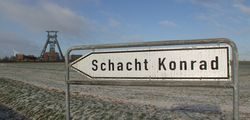
In recent years, Mayor Klingebiel had repeatedly spoken out against the intended quantitative and qualitative changes to the storage conditions for the Schacht Konrad repository and predicted resistance from the region.
The site-specific problems in the district of Wolfenbüttel and in the city of Braunschweig made it clear that the issue of "nuclear waste disposal" was of eminent importance for the future of the region.
In November last year, all political groups and Mayor Klingebiel unanimously passed a resolution in the city council calling on those responsible for nuclear waste in Berlin to include Schacht Konrad in the repository search process and to carry out a comprehensive reassessment in line with the current state of science and technology.
Furthermore, it was demanded that no attempt be made to expand the Konrad project and that there should be no changes to the operating license, but rather a halt to the Konrad preparations, as according to the current state of science and technology, the Konrad mine is ruled out from the outset as a storage site for nuclear waste, as Konrad (a former extraction mine) is located in a water-bearing layer and is designed to be non-retrievable.
In addition, the state government of Lower Saxony should support the demands made of the federal government and demand that the federal government reassess the Konrad repository as stipulated in the red-green coalition agreement.
In view of the lack of transparency regarding the quantities of nuclear waste and the associated question of where they should be disposed of, the Salzgitter City Council sees its long-held opinion confirmed that Salzgitter is being used by the Federal Government as the only option for solving the repository problem and that it has not shown the courage and the necessary consistency for a holistic solution scenario.
The Entsorgungsnachweis already provides for the possibility of tackling the problem of the additional capacities to be stored only after the commissioning of the Konrad mine in order to prevent a new planning approval procedure for the Konrad mine. This is based on the view that by shifting responsibility to the Federal Office for Nuclear Waste Management, it will be able to regulate an increase in capacity under its own jurisdiction.
The resolution continues: "Such an approach reveals the fear of having to give up Konrad as a final repository in the event of a reassessment and of being left empty-handed due to decades of failures in nuclear waste disposal policy. However, it also justifies the concerns of the population that, for tactical reasons, the plans are not being put on the table in advance in order to prevent them from being examined in a new planning approval procedure."
The valid permit from the Lower Saxony Ministry of the Environment for the storage of low- and medium-level radioactive nuclear waste in Schacht Konrad dates back to 2002 and covers 303,000 cubic meters.
The Federal Government's National Waste Disposal Program of 11 September provides for an expansion of the storage volume from the approved 303,000 to around 600,000 cubic meters after the Konrad mine is commissioned, in order to be able to store waste retrieved from Asse II and depleted uranium from uranium enrichment in Konrad.
Traffic obstructions on Hans-Böckler-Ring
Due to the panel discussion on the future of Schacht Konrad today, Thursday, March 26, in the auditorium of the Fredenberg grammar school and the large demonstration by IG Metall, the Schacht Konrad working group and the Braunschweig Landvolkverband, increased traffic volumes and thus traffic obstructions are to be expected, particularly on Hans-Böckler-Ring.
For this reason, this road will also be closed to traffic on one side. Residents of the residential area are asked to show understanding for this measure. The demonstration starts at 5 p.m., the discussion organized jointly by the Salzgitter Zeitung and the City of Salzgitter at 5.30 p.m.