

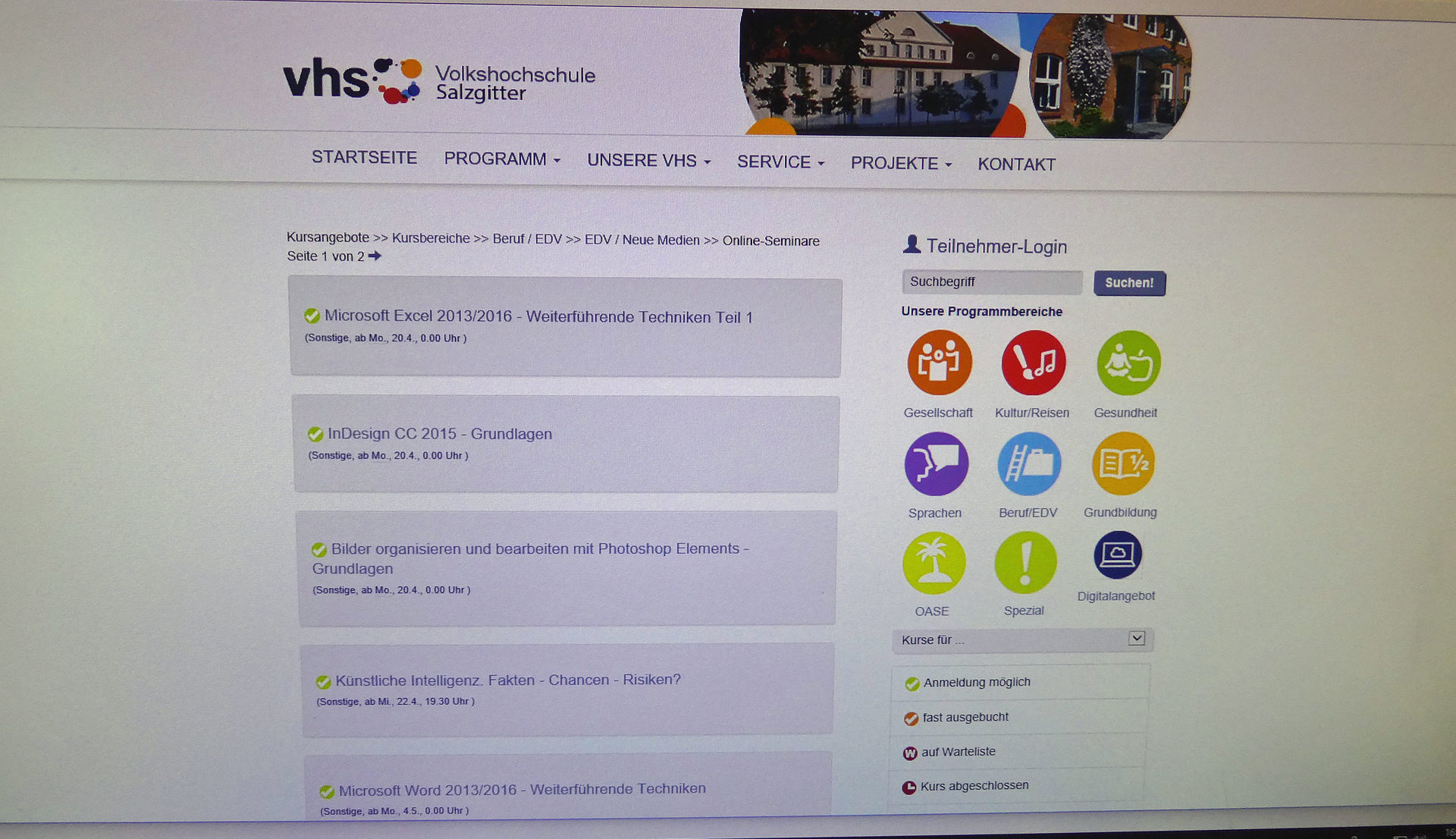
The cooperation with "VHS Wissen live" is new. Soccer, politics, contemporary history and other topics provide variety at home during the current period and invite discussion.
The Volkshochschule Salzgitter has entered into a cooperation with "VHS Wissen live": Top-class lectures by experts from science and society can be followed digitally. This can be followed by a live discussion with the experts. Anyone interested can register free of charge. The lectures cover culture, art, knowledge, politics, history and much more". "This virtual offering enriches the current online offerings and further education opportunities of our Volkshochschule," emphasizes Lord Mayor Frank Klingebiel. This form of knowledge transfer and exchange is a new path that the Volkshochschule is taking for citizens in the current situation.
On Wednesday, April 22, "Artificial intelligence. Facts, opportunities and risks" on the program. Artificial intelligence (AI) is no longer just an academic discipline. Since AI research products have become marketable, algorithms called "intelligent" are beginning to change more and more areas of our lives. We are torn between promises ranging from autonomous vehicles and robot butlers to individualized medicine, and horror scenarios ranging from manipulation and fakes to the surveillance state and the takeover of power by machines. The lecture attempts to clarify why this technology both confuses and fascinates us so much. The speaker will be Manuela Lenzen, a freelance science journalist and non-fiction author who is primarily known for her work in the fields of cognitive research and artificial intelligence. She is also a part-time research assistant at the Center for Interdisciplinary Research (ZiF) at Bielefeld University.
"The biology of happy love: is it all evolution - or could we do it differently?" is the title of the lecture on Thursday, April 23. Prof. Dr. Thomas Junker will talk about romantic love as one of the great myths of our time. It is revered and condemned, it can mean agonizing jealousy and deepest despair, but also supreme happiness, destroy friendships and sweep away moral systems. The speaker teaches the history of biosciences at the University of Tübingen. He has published numerous books and articles on the history and theory of evolutionary biology and anthropology.
The topic of peace ethics will be discussed on Tuesday, April 28. Under the title "No end to violence? What can peace ethics look like in the 21st century?", Prof. Dr. Eberhard Schockenhoff will speak about the paradigm shift that has taken place in peace ethics in recent decades. The speaker is one of the leading Catholic theologians. He is Professor of Moral Theology at the University of Freiburg and a full member of the Heidelberg Academy of Sciences and Humanities and the German Ethics Council.
Soccer fans can look forward to Monday, May 18: The focus will be on "Gerd Müller or "How big money came into soccer". Historian Hans Woller will talk about the footballer who has been described as the "eighth soccer wonder of the world" because he still holds all records as a goalscorer today. Who was this man who, as a provincial footballer from the poorest of backgrounds, rose to become a world star? The speaker describes the stages of this unusual career from a critical distance and at the same time full of empathy. The history of FC Bayern is always present.
On Wednesday, May 27, the focus will be on "Brazil: The destruction of democracy under Jair Bolsonaro". Dictators ruled the largest Latin American country from 1964 to 1985. There had also been phases of dictatorship in the decades before that. With the constitution of 1988, the danger of systematic state despotism seemed to have been averted and the will for a transparent democratic culture sealed. With the election of Jair Messias Bolsonaro as President of Brazil, the country has been set back decades and political achievements have been destroyed. What are the reasons for Bolsonaro's electoral success? What dangers does his policy pose for Brazil's future? The speaker, Ursula Prutsch, is a professor at the Institute of American Studies at LMU Munich. She teaches US and Latin American history.
The "Wissen live" lectures will conclude on Tuesday, June 9. Entitled "Herrschaft der Dinge. A new history of consumption and a look at tomorrow", the focus will be on our possessions and lifestyle.
The speaker, Frank Trentmann, is Professor of History at Birkbeck College, University of London. He studied and completed his doctorate at Harvard University and then taught at Princeton. In 2017, he received the Humboldt Research Award from the Alexander von Humboldt Foundation.
Further information:
Further details on the individual lectures can also be found on the Volkshochschule website(https://app-14.salzgitter.de, (opens in a new tab) then click on the individual sections)
All lectures start at 7.30 pm (until 9 pm).
If you would like to register for "Wissen live", you can register online at the Volkshochschule Salzgitter or send an email to vhsstadt.salzgitterde
Those interested will then be sent the relevant link and can then watch the lecture on the Internet at home on the relevant date and time and then have the opportunity to ask questions in the chat.