

The Eiszeitgarten in the outdoor area of the municipal museum shows what the animal and plant world looked like in Ice Age Central Europe, where people lived at that time. Two life-size figures of a woolly or fur rhinoceros, a mammoth and two hunters' huts can already be seen in the garden.
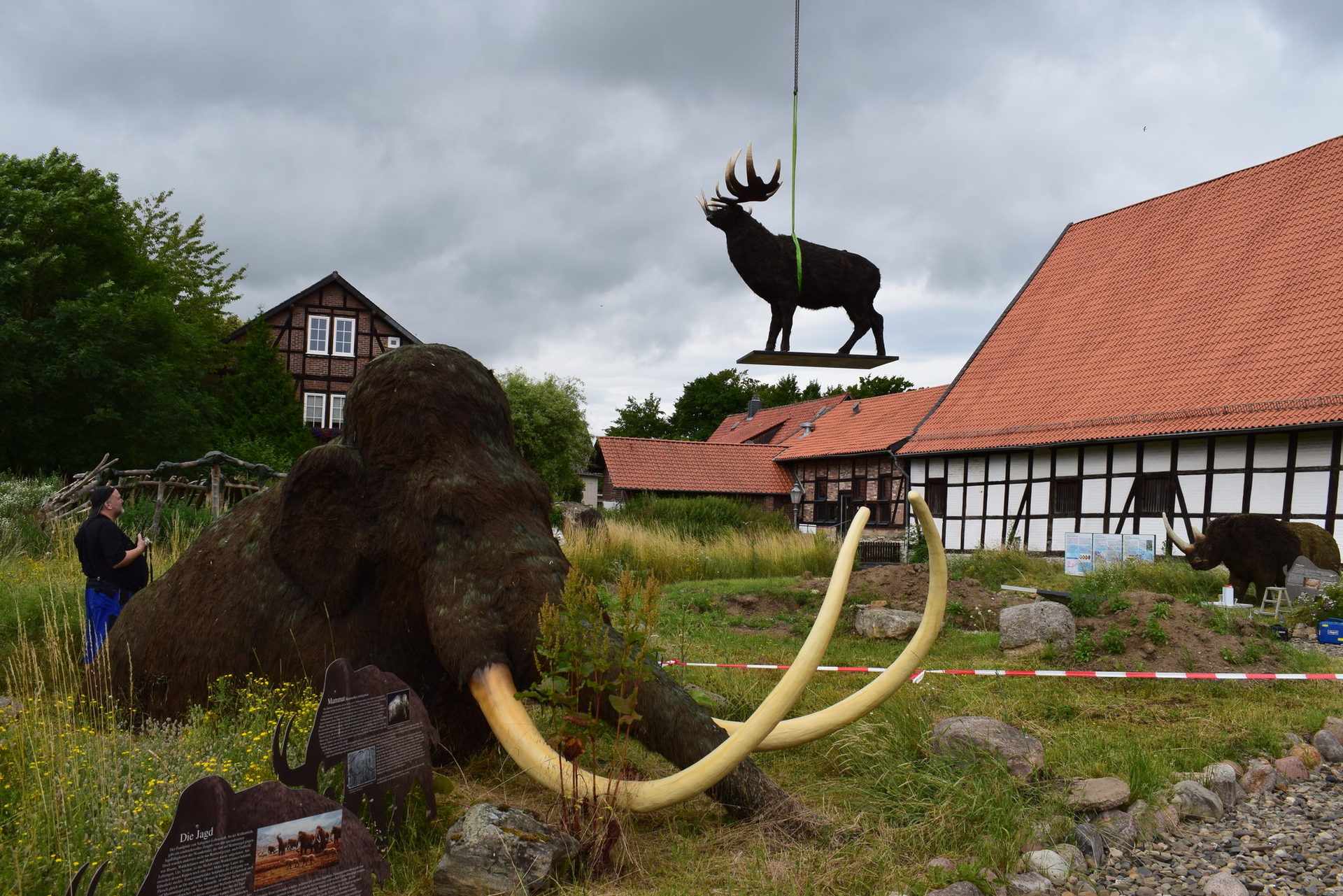
Eiszeitgarten opens with two new exhibits:
The best new news: the Eiszeitgarten will be open to visitors again from Saturday, July 10 during the museum's opening hours.
Due to the ongoing pandemic situation, access is limited for the time being. The state government's distancing and hygiene rules apply in the Eiszeitgarten.
Interested guests should report to the supervisor in the castle building.
And here's what's new in the Eiszeitgarten:
- The new "reindeer wall" is over 10 meters long and up to 2 meters high:
The wall is covered with weather-resistant foil on which a herd of reindeer can be seen running. It gives an excellent impression of the natural force of such a herd in motion. - The life-size figure of a giant deer made of fiberglass and artificial fur:
The figure is a depiction of not just any subspecies, but the largest and best-known representative: Megaloceros giganteus!
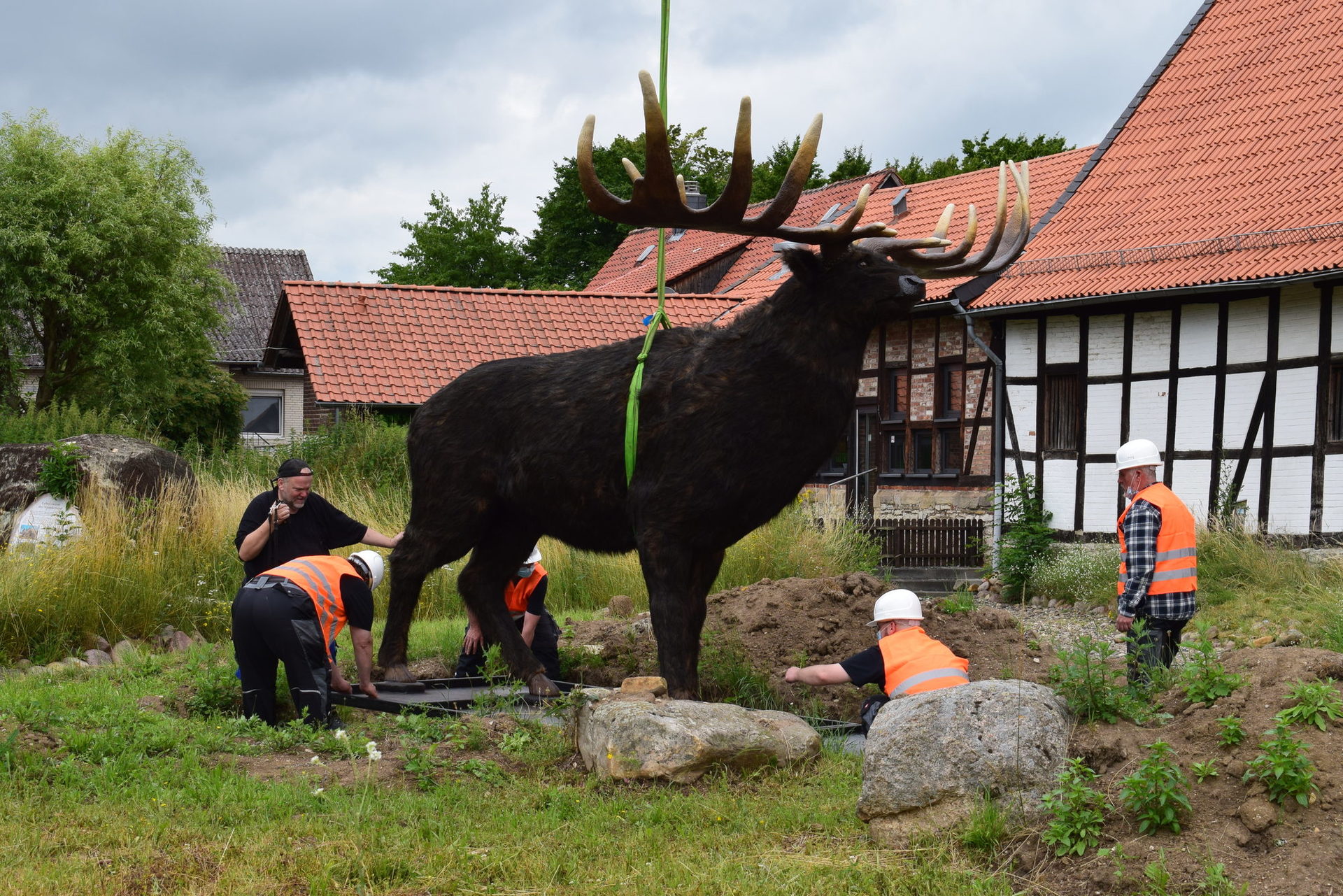
The giant deer "Megaloceros giganteus" lived in Eurasia for around 400,000 years. It became extinct in Europe at the end of the last glacial period around 11,500 years ago. The giant animals must also have roamed the area of today's Salzgitter. It is unclear why they became extinct, but humans probably contributed to this through intensive hunting.
Megaloceros giganteus had a shoulder height of a good two meters - so it was about the same size as a modern elk. However, it was lighter and more leggy. By comparison, a red deer stands at just 1.30 meters.
Only male giant deer had antlers. They could reach a span of 3.60 meters and were larger than the antlers of any deer alive today. However, it was not the largest deer of all time. There were some much larger forms of giant elk.
Where does the figure come from?
The giant deer was "born" in the workshop of Dinopark Münchehagen in Rehburg-Loccum. It was built by hand by GRP technicians and painters. Their work is based on bone finds and scientific research into the extinct species.
The figure weighs around 250 kilograms and was lifted over the roof of the museum's outbuilding with the help of a crane from Fricke-Schmidbauer (90-ton crane).

Financing of the project:
A large part of the costs incurred for the figure were covered by the Förderkreis Schloss Salder with 20,000 euros, plus 2,000 euros financed by the Lions Club Schloss Salder. The remaining costs for the necessary substructure and the complex crane transport "over the roof" were borne by the Salder Castle Municipal Museum itself.
