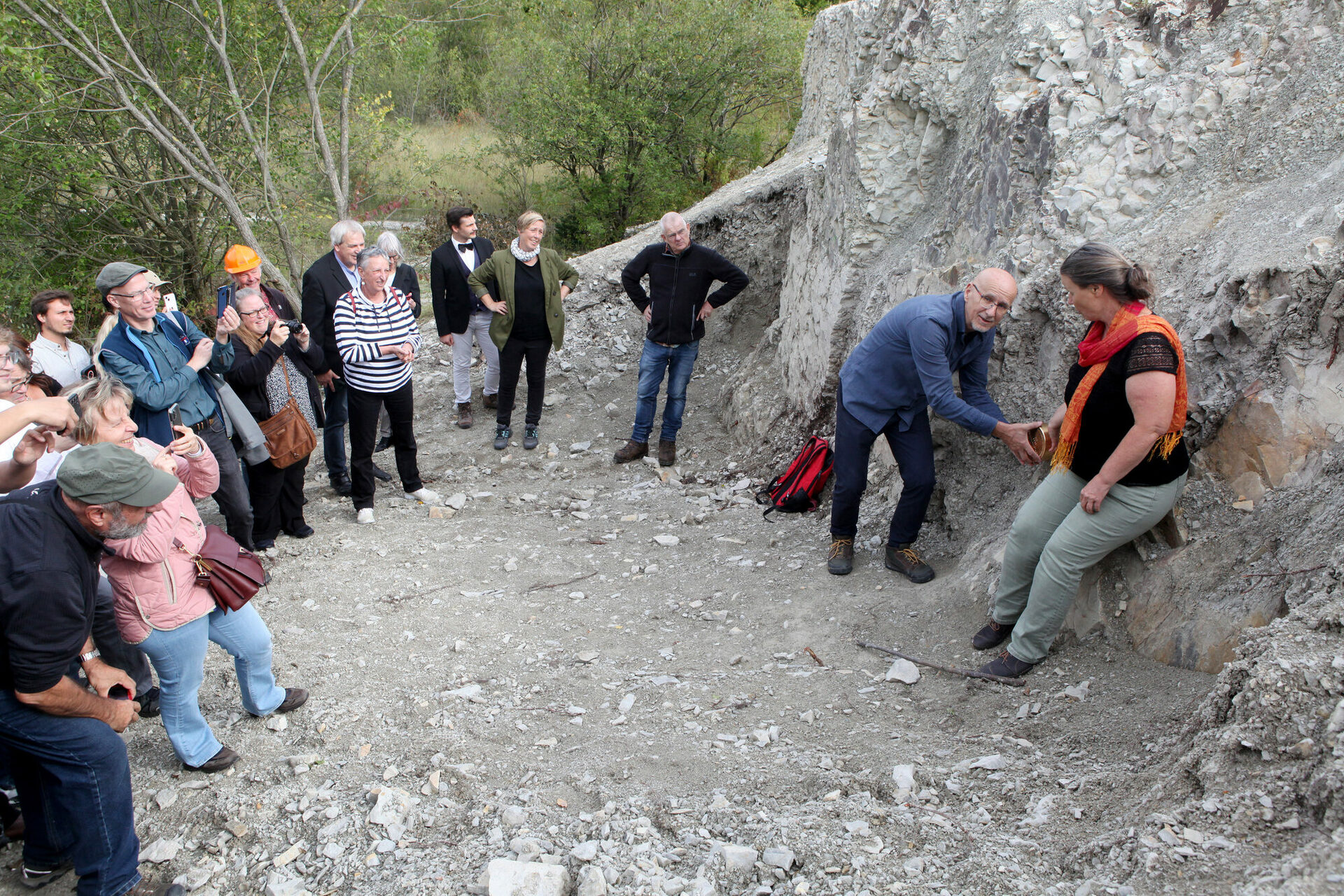
It marks the point in the quarry wall where the geological changes at the boundary of the two Cretaceous periods Turonian and Coniac can be recognized in a unique way. The International Union of Geological Sciences (ICS) had established that this time boundary is nowhere better traced than in the Salder quarry and awarded the strata profile the significant title of "Global Stratotype Section and Point" (GSSP - also known colloquially as the "Golden Nail").
ICS Secretary General Philip Gibbard and Marie Rose Petrizzo (head of the ICS commission responsible for this geological age) emphasized the complex procedure behind the awarding of a "Golden Nail". Both made it clear that many test procedures and high-quality criteria are applied in order to distinguish such layer transitions before they can serve as a reference point for further research worldwide.
"This is a great honor for geology, but it is also a great honor for the people of Salzgitter," said Christian Striese, Second Mayor of the city. This is only the second time in Germany that a "Golden Nail" has been awarded. Prof. Ireneusz Walaszczyk from the University of Warsaw, who, together with Prof. Silke Voigt from Goethe University Frankfurt and with the support of Dr. André Bornemann from the State Office for Mining, Energy and Geology (LBEG) and other geoscientists, examined the 40 meters of geological strata in the former limestone quarry on Hasselberg in detail, explained how perfectly and seamlessly the transition between the two eras has been documented. Similar sequences of layers have been found in the south of the USA and in Mexico, but none meet the strict criteria of the ICS as well as those in Salzgitter-Salder.
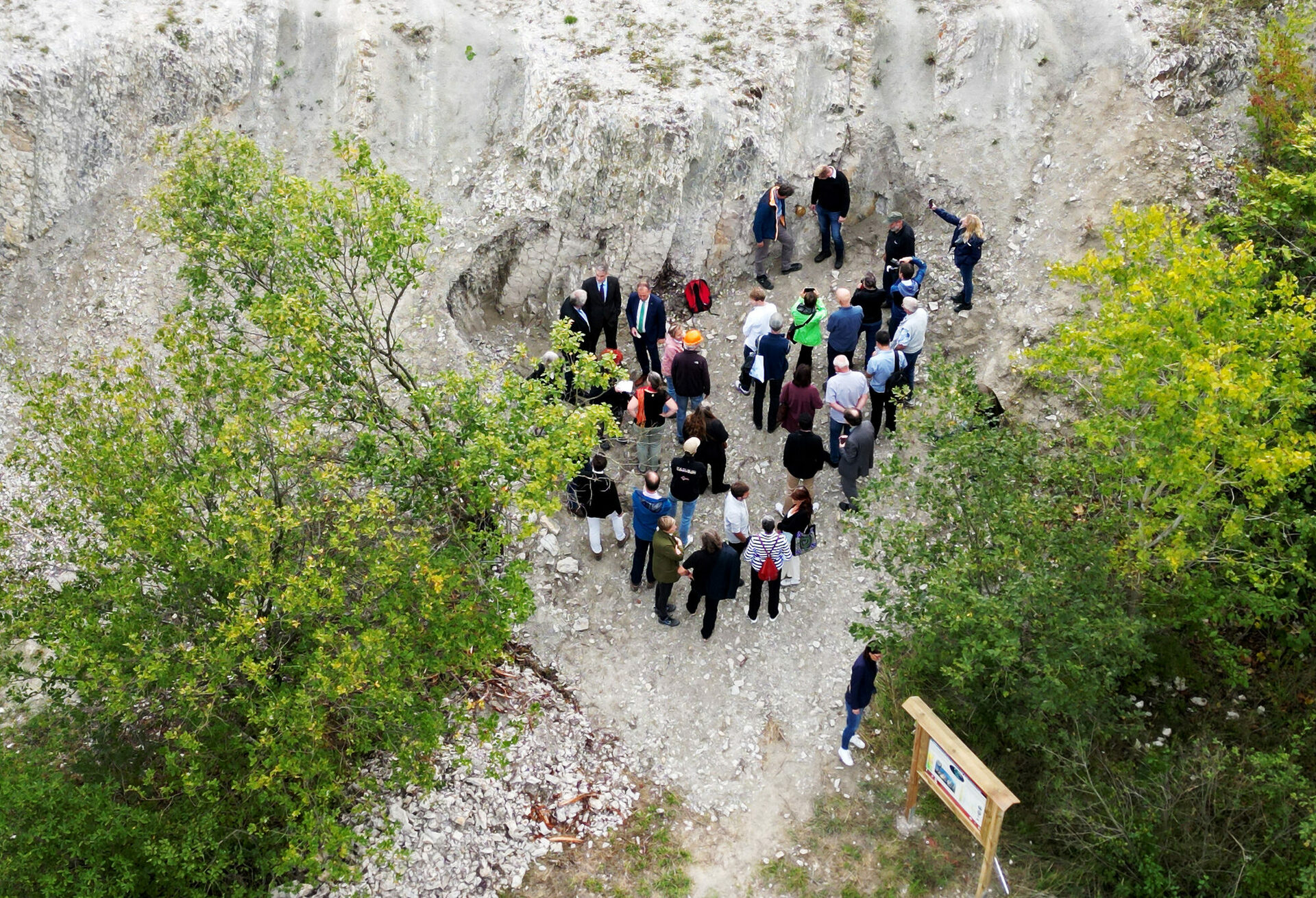
The "Golden Nail" now makes this visible, which Prof. Silke Voigt is particularly pleased about. "Geology can be experienced here and we can show our children and pupils how important this science is." Henning Zellmer, Managing Director of the Harz - Braunschweiger Land - Ostfalen Geopark, is hoping for a similarly sustainable effect: "This way, we can leave valuable geotopes for posterity." The Geopark is responsible for maintaining the geotope.
Markus Stöwer, Head of Department at the LBEG, said: "I am delighted that we now have such an important award in Lower Saxony and that we can provide the basis for such outstanding research results with our geological and stratigraphic work."