

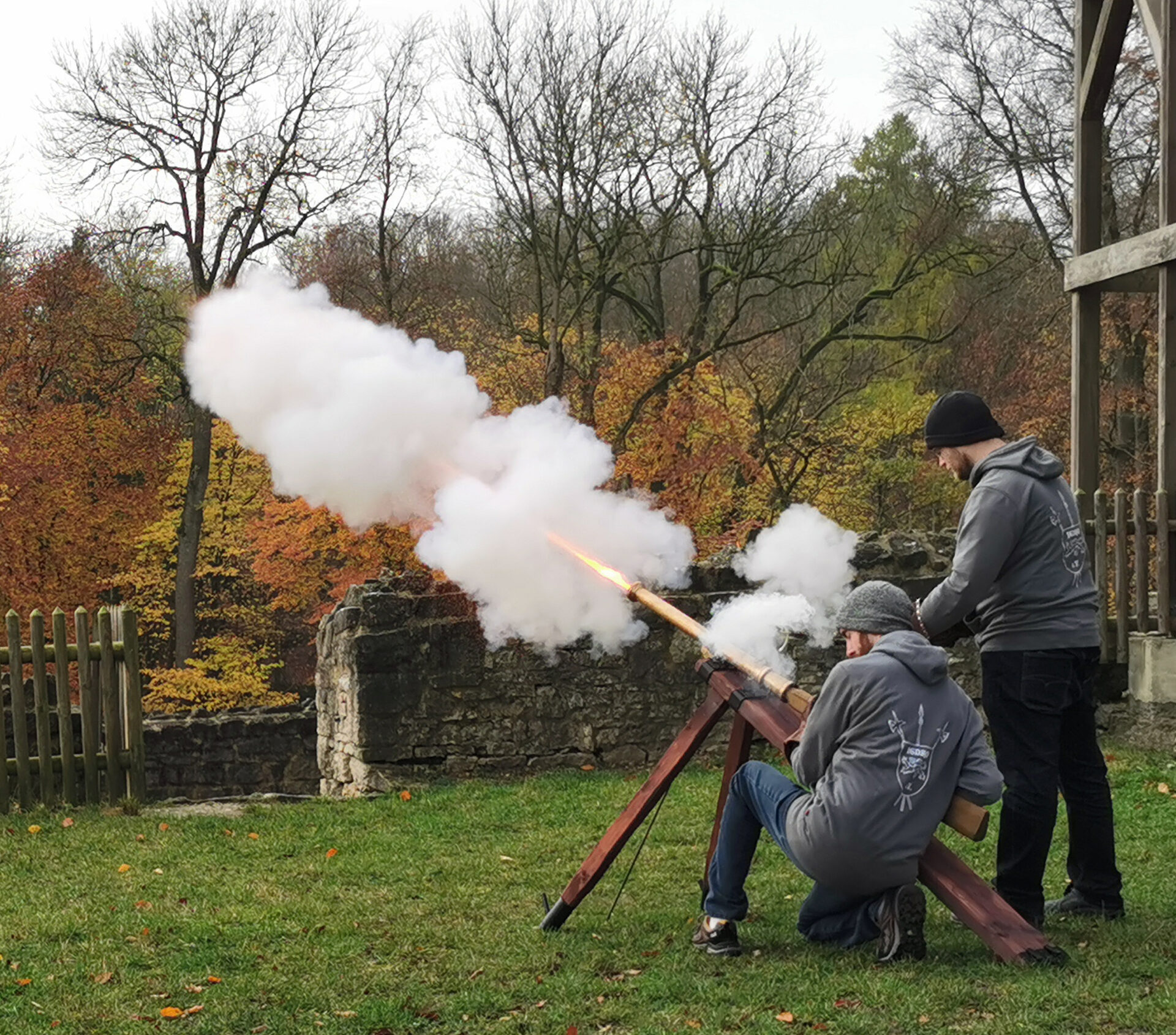
Four shots with 30 grams of powder each proved the quality of the replica, which will soon be on display at the Salder Castle Municipal Museum.
The find and its reconstruction
It was a sensational late medieval find at the well-known medieval castle ruins of Lichtenberg in Salzgitter. During excavations decades ago, part of a bronze late medieval / early modern hook rifle was found. This type of handgun was mainly used in the 15th and 16th centuries. Its name comes from the hook attached to the bottom of the barrel, which could be placed on a wall, for example, to absorb the recoil from the shot. The exciting find from Lichtenberg has two engraved coats of arms on the hook - very unusual for such weapons. These have already made it possible to assign it to the noble von Cramm family and roughly date it to the decades around 1500. The Salder Castle Municipal Museum commissioned a complete replica of the remarkable find in 2021.
The complete reconstruction of the weapon, including research, reconstruction, casting of the barrel from gun bronze and production of the wooden stock, was carried out for the Salder Castle Municipal Museum by the well-known archaeometallurgist Dr. Bastian Asmus. He painstakingly reconstructed what the Lichtenberg find must have once looked like using completely preserved comparative pieces. The result was a wooden model that served as the basis for casting the replica of the hooked rifle. The finished piece could then be admired by the public at the museum festival in 2022. However, the hook rifle was not quite finished back then. In order to bring the past back to life, it was to be fired with black powder. But as a "firecracker", without a projectile. This first required a test at the Suhl Proof House. Once this had been approved, nothing stood in the way of the first test.
Test of the replica of the historical weapon
The first firing took place at the historical site: the ruins of Lichtenberg Castle. Members of the museum team, the Lichtenberg Castle Friends' Association, the press and the Oderwald Thirty Years' War interest group had gathered here in beautiful autumn weather. A few random onlookers were also invited to watch. However, at a safe distance, as only two members of IG Dreißigjähriger Krieg Oderwald, Ulf Kalb and Christoph Weinzettel, handled the weapon to guarantee the safety of the eyewitnesses. One of them held the hooked rifle, which had previously been loaded with black powder and "hooked" onto a specially made stand, while the other ignited it using a fuse attached to a stick.
Fortunately, after the first big bang - after all, 30 grams of black powder are ignited per shot - it was clear that the replica would be spared the fate of the historical model! This was probably - at least according to material tests - once exploded when fired due to casting defects in the bronze and / or too much black powder. However, the replica works perfectly and was therefore fired four times. The spectacle was met with great enthusiasm by all those present, as it brought a long-forgotten piece of the city's history back to life.
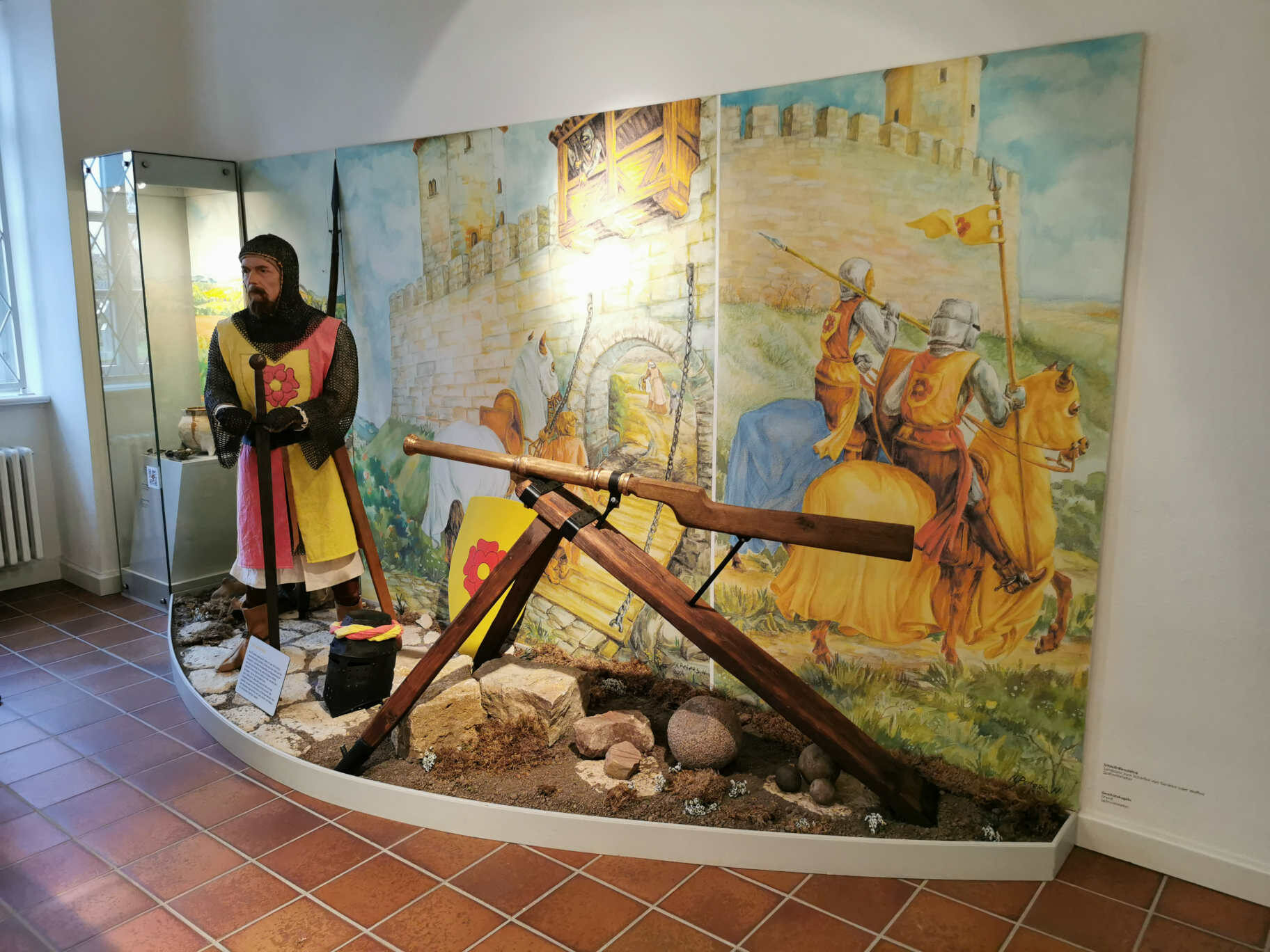
On display at Salder Castle
The original find of the "hook" from Lichtenberg Castle and the replica of the hook rifle can be viewed in the Salder Castle Municipal Museum.
The reconstructed hook rifle is mounted on a stand made by the museum workshop and professionally secured in the section of the permanent exhibition on Lichtenberg Castle. Alongside the classic knight from around 1300, it symbolizes the end of the castles themselves with the advent of firearms and in particular the destruction of Lichtenberg Castle in 1552.

