

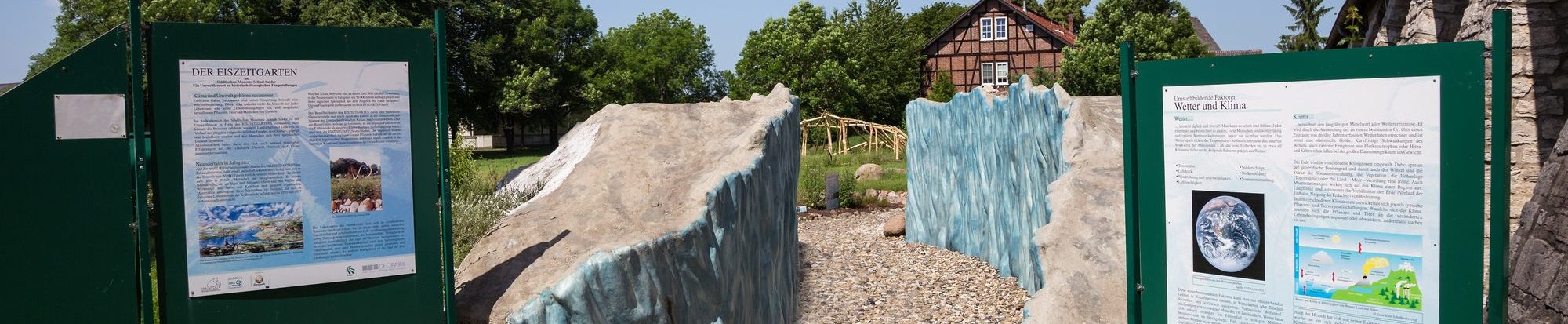
The Eiszeitgarten is open to visitors during the museum's opening hours.
The Eiszeitgarten

In conjunction with the permanent archaeological exhibition in Salder Castle on the subject of "50,000 years of life in Salzgitter", the Eiszeitgarten illustrates the living conditions of the Neanderthals, who, as the finds at Krähenriede in Lebenstedt prove, went hunting in the northern Harz foreland at the beginning of the last Ice Age.
In the Eiszeitgarten, the importance of nature and climate for the cultural development of humans in the Ice Age environment is presented. Based on the findings from the archaeological work at the important Krähenriede site in Salzgitter-Lebenstedt, it is possible to illustrate the environmental conditions under which Ice Age man lived, hunted and fed himself. The topics of climate and climate change also play a role.
In the Eiszeitgarten, visitors are given an insight into the most recent geological past. To this end, the meadow between the Municipal Museum's sheepfold and the small river Fuhse was first ploughed into a meagre site and a subarctic landscape was created. A planting island was created with selected herbs and shrubs.
Life-size animal sculptures of mammoths, woolly rhinoceroses and giant deer illustrate the animal world of the Ice Age. A mammoth track crosses the garden. Shelters offer visitors the opportunity to stay there in wind and weather. Children's birthday parties are also organized here.
