

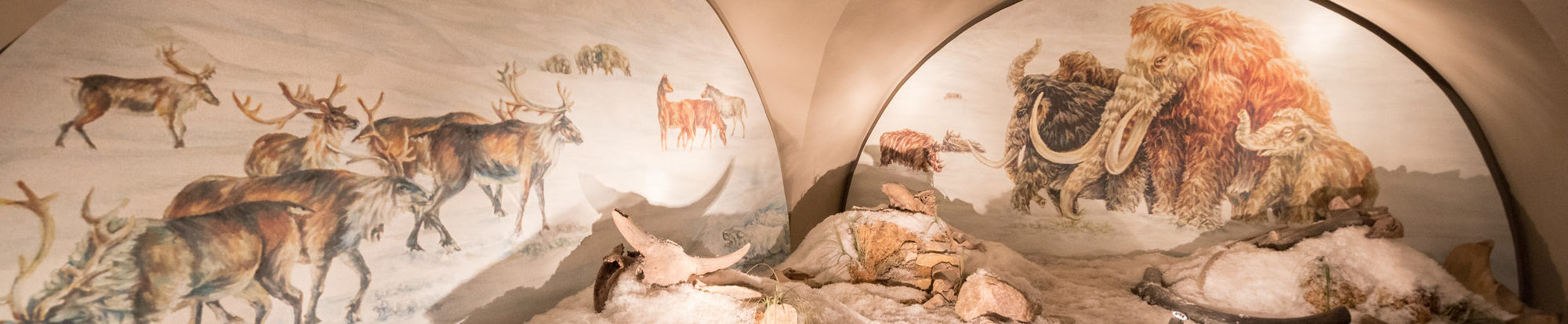
Over the 4.6 billion years that have passed since the formation of our planet, the face of the Earth has changed time and again. Continents have drifted together and apart again, seas have formed and mountains have been folded up. The animal and plant world has also changed. Large insects and giant dinosaurs have dominated the world, become extinct and other species, such as mammals, now populate our planet. Traces of these fascinating, often seemingly alien creatures from the last 270 million years of our planet's history have also been preserved in the rocks deposited in the Salzgitter region. A selection of these fossils and the corresponding life images in the castle vault take visitors on a journey into the primeval worlds from the end of the Palaeozoic era to the modern era.

Star of the collection
The star of the collection is an ichthyosaur (fish dinosaur) almost five meters in size, which lived 115 million years ago in the Lower Cretaceous Sea. The skeleton found in Salzgitter in 1940 is the only specimen of a Platypterygius hercynicus to date. The habitat of most of the creatures found in the Salzgitter area was the sea. The mineral resources of salt and iron ore, which were so important for the development of the city, are also a legacy of the seas. Iron ore was deposited in the Salzgitter area twice, each time 30 million years apart, in the Upper Jurassic and Lower Cretaceous periods. The formation and deposition of these iron ores and the salt rocks precipitated during the Zechstein period are presented in detail in the exhibition.
Tooth and bone finds from the region
Another highlight of the collection are the tooth and bone finds of Ice Age animals from Lake Salzgitter. Mammoth, woolly rhinoceros and giant deer populated the steppes here in the last ice ages. You can experience geology live on a hike through the Lichtenberge and the Salzgitter mountain range.
The Salzgitter-Lichtenberg and Salzgitter-Bad Geopfads are circular hiking trails that lead to the layers of rock where fossilized evidence can still be found millions of years later. A hiking map and text panels on site complement the journey through the history of the earth in the castle vault.
 read out