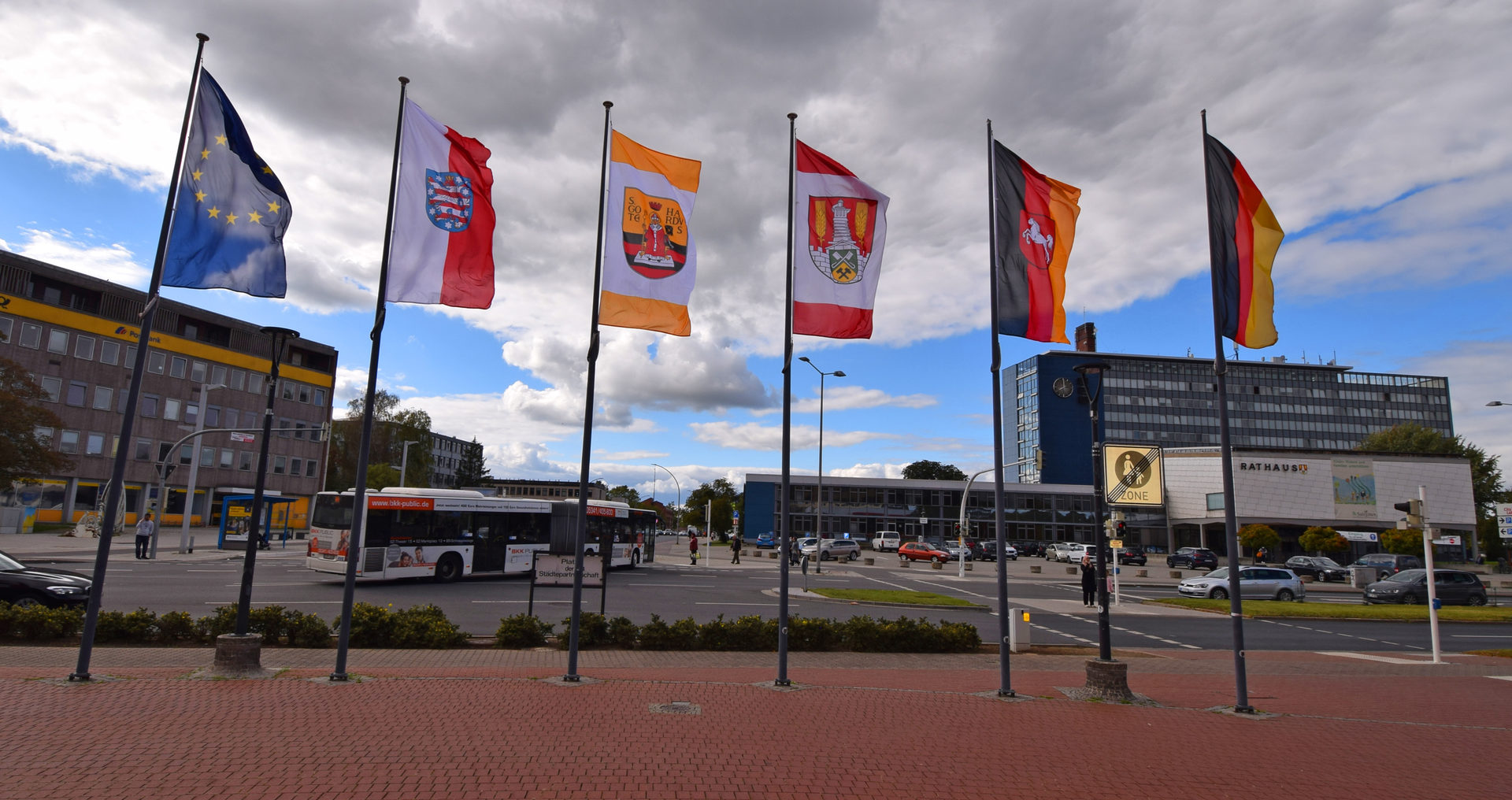
In recent months, the flags of Salzgitter have been flown at the town twinning square on national holidays and town anniversaries. On the Day of German Unity, the city of Salzgitter flies the flag of the European Union, the national flag of Germany, the state flags of Thuringia and Lower Saxony and the flag with the Gotha and Salzgitter coats of arms in friendly solidarity with the twin town of Gotha.
But where does the name Gotha come from, does it have anything to do with the patron saint of the city, St. Godehard, who is depicted on Gotha's coat of arms?
The fact is that St. Godehard (Gotthard of Hildesheim, also known as Gothardus in Gotha) is the patron saint of the town of Gotha. The Gothardus Festival is celebrated there in honor of the patron saint every year at the beginning of May, around the anniversary of his death on 5 May 1038.
When and why the saint became the patron saint of the town has not yet been clarified. The connection is probably due to the fact that Godehard was abbot of Hersfeld Monastery from 1005 to 1012. At this time, the town of Gotha was still owned by the monastery. "However, the name Gotha does not come from St. Godehard," reports Gotha's town historian Dr. Alexander Krünes. According to an old document from the year 775, it comes from a settlement called Villa Gothaha, which can be translated as "good water".
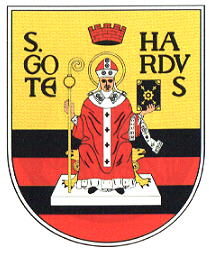
The coat of arms shows St. Godehard (Gotthard of Hildesheim). His portrait first appears in the town seal in 1253. However, he does not yet appear in the city's coat of arms in the Middle Ages. It was not until the end of the 17th century that he became tangible here. In 1865, the then mayor Hünersdorf had Gotha's coat of arms redesigned and gave it the form it still largely has today. The lettering "St. God(e)hardus" was taken from the town seal and placed to the right and left of the saint. Gotthard himself was depicted sitting in a bishop's habit in a griffin's chair. He holds the crosier in his right hand and a book in his left. He was also given a halo (this is sometimes missing on the old city seals). The floating mural crown above his head was added somewhat later.
During the National Socialist era and the early GDR period, Gotha's coat of arms was to be completely changed once again. Up to 70 drafts for the redesign can be found in the Gotha city archives. Unfortunately, it is no longer possible to say why the old coat of arms was retained in the end.
There was only one change to the coat of arms after the political change in 1989: the griffins on the armchair became lions.
In July, members of the Salzgitter Ecumenical Working Group were also on the trail of the town's history when they visited our twin town of Gotha despite social distancing and hygiene requirements. Gotha's Lord Mayor Knut Kreuch took the opportunity to welcome the group in person.
