

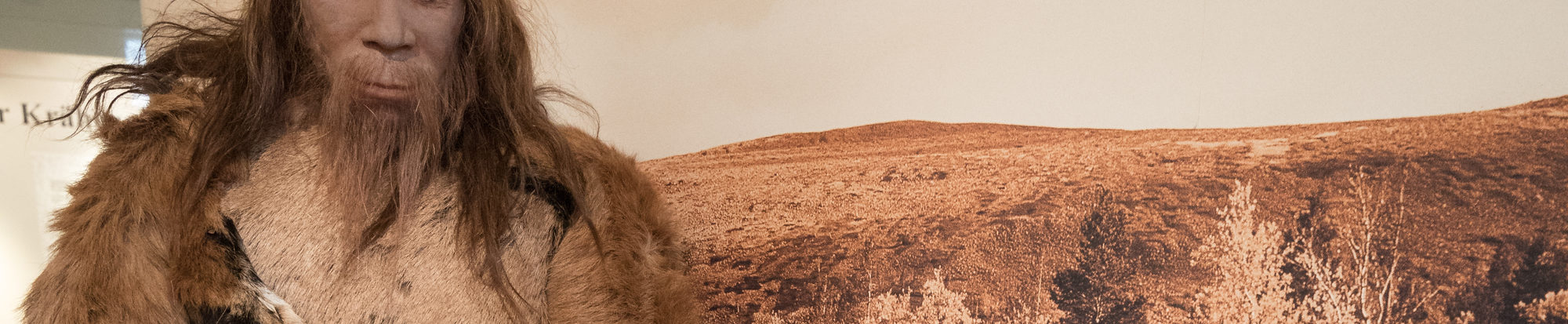

Neanderthals in Salzgitter
In 1952, the open-air station at Krähenriede was discovered during construction work in the north of Salzgitter-Lebenstedt. Many finds proved that a Neanderthal hunting station was located here 50,000 years ago.
During excavation work for a new sewage treatment plant in 1952, the bones of Ice Age animals were discovered at a depth of around five meters. Flint tools were also discovered a short time later. After just two days of trial excavations, it became clear that undisturbed prehistoric layers had been found here. A four-month scientific investigation involving geologists, botanists, zoologists and archaeologists was carried out with great technical and financial difficulties. Research into the Palaeolithic period in Salzgitter continued in 1977, when renewed construction work in the area of the sewage treatment plant enabled a further excavation campaign lasting six months. A total area of around 400 square meters was investigated. The results of the excavations in Salzgitter-Lebenstedt still give rise to scientific discussions today.
Geological analyses of the sequence of layers and the zoological and botanical finds that have been preserved allow us to form a picture of the Palaeolithic environment in the Salzgitter area and reconstruct what happened here 50,000 years ago:
In the broad primeval valley, hunters camped on the north-eastern edge of the valley in the shelter of the then much higher valley slope. The camp site was located in the immediate vicinity of a stream, the Krähenriede. Varying water levels led to partial sedimentation and the creation of small ponds and oxbow lakes. This favorable natural situation combined with its location directly above a salt dome attracted both animals and people. This site was probably visited several times in late summer and fall. From here it was possible to observe the migration of the herds and organize the hunt.
Almost 3,000 bones from at least 86 reindeer and 17 mammoths compared to eight horses, one bison and four woolly rhinoceroses indicate a specialization in hunting certain animals. Butchery marks on the bones show that reindeer were hunted specifically to obtain the nutritious bone marrow and hides. Collected mammoth bones were processed into bone tools. Baltic flint nodules, which were available from older glacial deposits in the surrounding area, were used as raw material for making tools on site. Large stones arranged in a circle could have served as weighting stones for simple tents.
Among the rich find material, which consists of several thousand flint, bone and antler artifacts, fish, poultry, beetle and plant remains and pollen, human bone remains were only discovered in 1963. Two skull bones, which were supplemented by a third matching fragment in 1976, provide evidence of Neanderthals in Salzgitter
