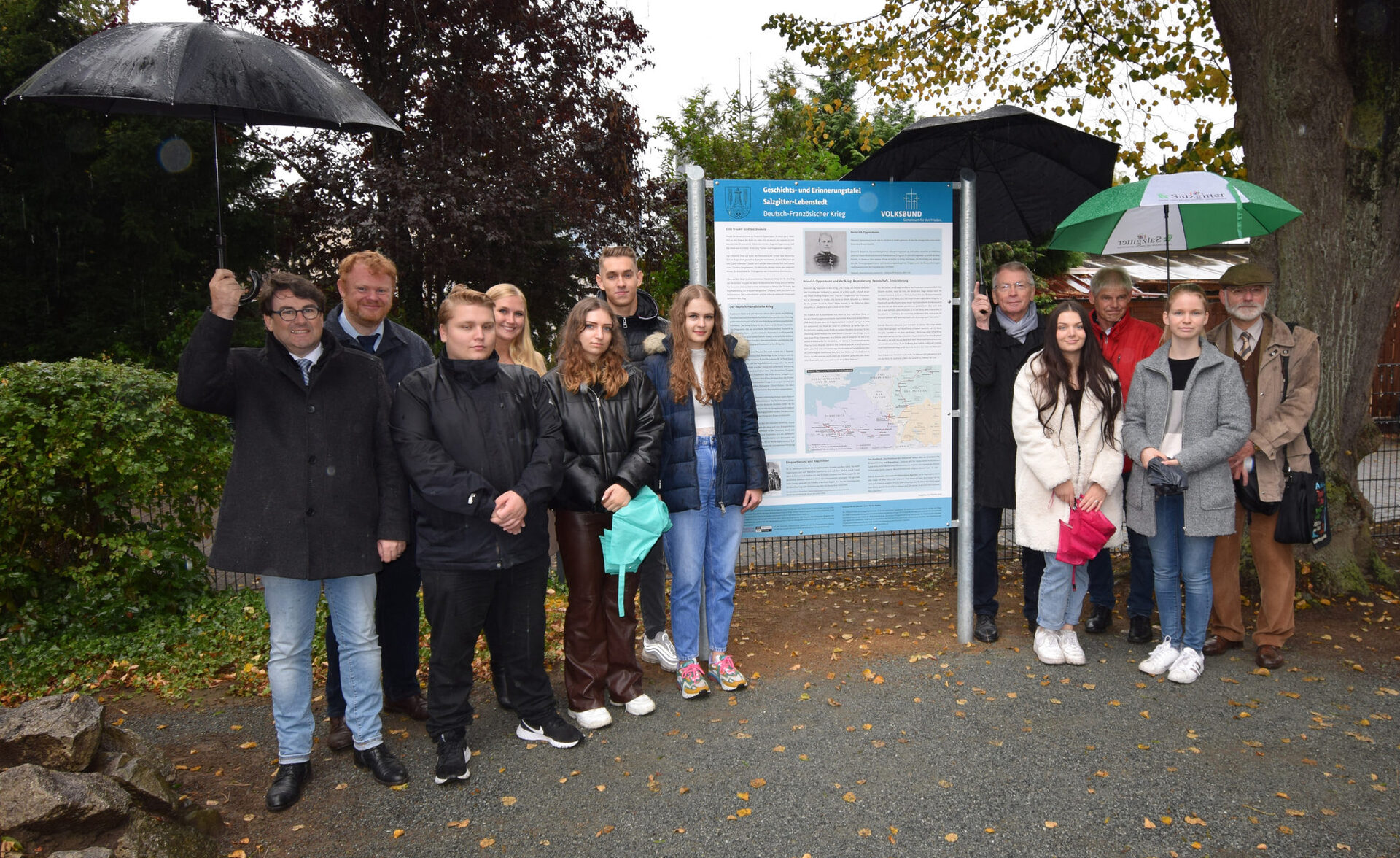
At the ceremonial inauguration of the history and memorial plaque, Mayor Frank Klingebiel, who is also the district chairman of the Volksbund Deutsche Kriegsgräberfürsorge Salzgitter e.V., was delighted and said: "This is an extremely successful cooperation between IGS Salzgitter and the Volksbund. It gives our pupils the unique opportunity to explore history in a hands-on way using a concrete example. Your work, dear pupils, is a clear sign of peace, freedom and democracy, which we must stand up for every day, because we cannot take them for granted. I am deeply convinced that lasting peace can only be achieved through active, open and honest international understanding. And there can only be a good future if we are aware of history and actively come to terms with the past."
Walter-Johannes Herrmann, Chairman of the Braunschweig District Association of the Volksbund, added: "This practical work makes history lessons tangible and therefore more sustainable." Hans-Jürgen Gatzen, senior school coordinator at IGS Salzgitter, agreed: "History is part of civic education. Using concrete examples, we can convey that war is still a danger and that it is our responsibility to do something about it.
About the project:
This is a project supported by the education officer of the Volksbund Deutsche Kriegsgräberfürsorge e.V. Dr. Rainer Bendick. Based on a war memorial at the Old Cemetery in Salzgitter-Lebenstedt, the participating pupils studied Heinrich Oppermann, whom the memorial commemorates. The project work focused on his life and in particular his experiences in the Franco-Prussian War of 1870/71, in which he himself fought and died as a result of dysentery in the military hospital in Château-du-Loir. Based on Oppermann's letters, which he wrote back home, the project dealt with the topics of the Franco-German war, justification of wars, brutalization of soldiers, treatment of the civilian population and, from a sociological perspective, the mechanisms for building up hatred and enmity.
The result of this project is a historical and commemorative plaque that will inform visitors to the Old Cemetery about the historical background of the war memorial. The Braunschweigische Sparkassenstiftung and the network "Schule ohne Rassismus - Schule mit Courage" (School without Racism - School with Courage) sponsored the costs of around 800 euros.
About the person Heinrich Oppermann:
Heinrich Oppermann was born in Salder on July 15, 1846. He was the only son of a wealthy farming family. Oppermann served in the Brunswick Infantry Regiment 92 and took part in the Franco-Prussian War, first as a private and then as a non-commissioned officer. He wrote a total of 44 letters to his family in which he reported on his everyday life as a soldier during the war: the horrors of battle, the supply problems and equipment shortages of the troops as well as the billeting and requisitioning of French civilians. It is clear from his letters that the sight of the battlefields of Mars La Tour and Saint Privat and the destruction left him deeply disillusioned. He wrote to his parents: "You can be glad that the torch of war is not burning near you, it is really miserable; the misery of the people is terrible, they are all becoming poor."
He died of dysentery on March 5, 1871 at the age of 25 in a military hospital in Château-du-Loir (France). His mother, Auguste Oppermann, had the monument erected. It is both a memorial and a victory column. Oppermann's grave in Château-du-Loir was previously unknown. Dr. Rainer Bendick found it again and campaigned for a commemorative plaque to be attached to the local memorial in the cemetery, on which the names of the French and German war dead are inscribed.