

In 940, Count Immat founded a nunnery and the first predecessor building of the current church of St. Abdon and Sennen must also date from this time.
In 1153, the nuns were replaced by the male Benedictine order. At that time, the church was only 2/3 as long as it is today and much lower. On the west side, where the main entrance was located, it had a tower and two chapels.
In 1596, a fire damaged the church so badly that it was not until the appointment of Abdon Könich as abbot in 1694 that reconstruction and rebuilding began.
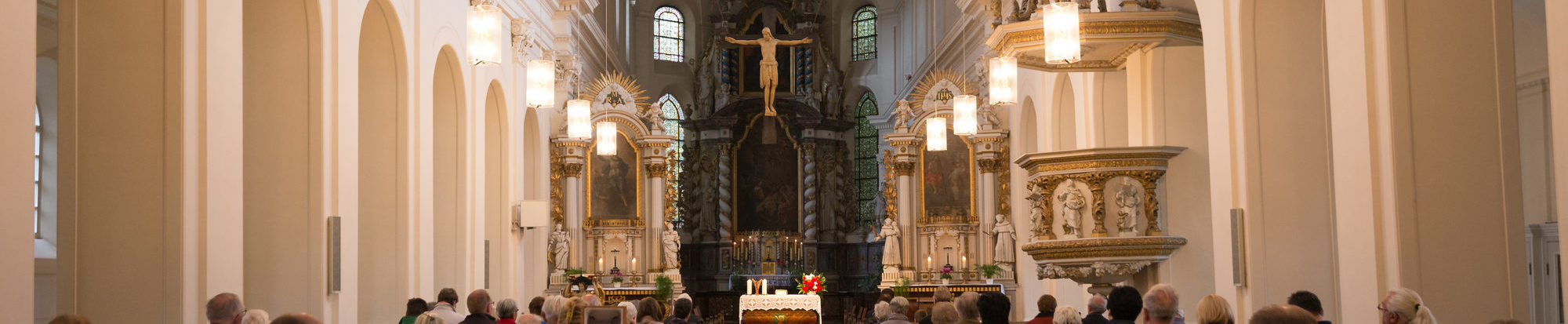
The church belonging to the monastery was rebuilt as a baroque church. The walls of the central nave and the side aisles were raised by several meters and the church was given a roof decorated with pointed dormers and a bell tower designed as a ridge turret. Abdon Könich had the interior lavishly decorated in Baroque style and commissioned the highly famous organ from Andreas Schweimb in Einbeck.
Abbot Bernward Peumann had the baroque façade built in 1730, together with the grand staircase. The interior of the church was redesigned in 1796 by the last abbot, Godehard Arnoldi, to reflect the taste of the time. The side altars were newly created but were stylistically based on the main altar. The church is a unique sacred building in Salzgitter and today serves as a Catholic parish church.
Worth seeing is the valuable baroque organ, which is one of the best of its kind in northern Germany, and the limewood crucifix from the workshop of Bishop Bernward, which was created around 1000. After the Gero Cross in Cologne, it is the oldest large crucifix in Germany.
Every spring, the church hosts the Ringelheim Organ Festival with renowned artists.