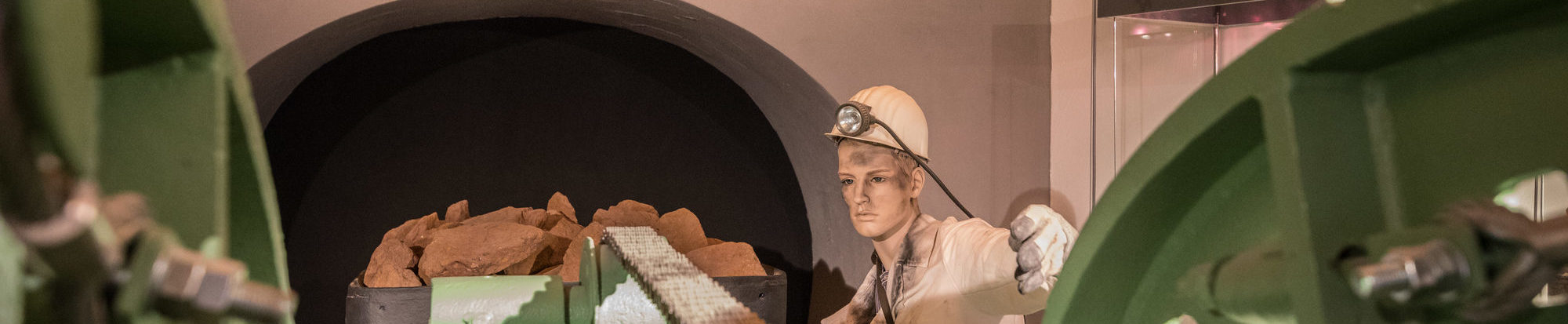
The Bartelszeche, Worthlah, Galberg and Gitter shafts, which were already under construction, were transferred from Vereinigte Stahlwerke, the Hannoversche Treue and Bergmannstrost opencast mines from Ilseder Hütte and the Finkenkuhle mine from VESTAG to Reichswerke. The expansion was continued immediately and the construction of new mines began. The plans initially envisaged five mines consisting of 21 shafts, including auxiliary and ventilation shafts and three large opencast mines. On the western flank of the Salzgitter ridge, the Haverlahwiese ore mine was built with shaft operations and the largest open-cast mine (length: 3 km, depth: 100 m) of its time in the German Reich. On the eastern side of the ridge, construction of the Hannoversche Treue ore mine (open-cast and underground mining) continued, the Finkenkuhle open-cast and underground mine was further expanded and another shaft was sunk with Georg. At the outbreak of the Second World War, around ten percent of all ore mined in the German Reich was already being extracted in the Salzgitter region - the three open-cast mines alone produced 2,000 tons per day. Until September 1939, the mined ore was mainly delivered to the smelters on the Rhine and Ruhr. When the first blast furnace was completed in October 1939, the ore could be smelted directly on site.
The new beginning after the end of the Second World War was not easy for the Salzgitter ore mining industry. In November 1945, the Haverlahwiese open-cast mine was the first mine of the new Salzgitter Erzbergbau G.M.B.H. to resume production under the trusteeship of the Allies. The Hannoversche Treue, Finkenkuhle and Worthlah opencast and underground mines followed in 1946. Georg was the last shaft to go back into production in 1948.
During the economic boom, the mines in Salzgitter, with around 6,200 employees (as of 1957), extracted 5.2 million tons of iron ore per year (as of 1959). At the beginning of the 1960s, the mining crisis in Salzgitter gradually began. The West German smelters, but also Salzgitter AG, were extracting less and less domestic ore due to cheaper ore imports. Mine after mine was closed. Erzbergbau Salzgitter AG was dissolved in 1976. Thanks to a research project supported by the federal government, Haverlahwiese was able to continue operating on a reduced scale as a controlled operation of Peine-Salzgitter AG. On June 30, 1982, this last remaining iron ore mine in Salzgitter was also closed.
By 1975, a total of 172.17 million tons of Lower Cretaceous iron ore had been extracted, 136.37 million tons of which came from the mines in Salzgitter. This made the extraction of this Lower Chalk ore the most significant in Germany.
Among the iron mines in Salzgitter, the Konrad mine still occupies a special position in several respects. It was only built in the years 1958 - 62 and, with depths of between 900 and 1,300 meters, is also the deepest. The ore mined here, which was first discovered during exploratory drilling for crude oil in the early 1930s, is coralloolite iron ore from the Upper Jurassic (Malm). Mining was also stopped here in 1976. However, the mine is still being kept operational and has been converted into a repository for a maximum of 303,000 m³ of radioactive waste with negligible heat generation since 2007.