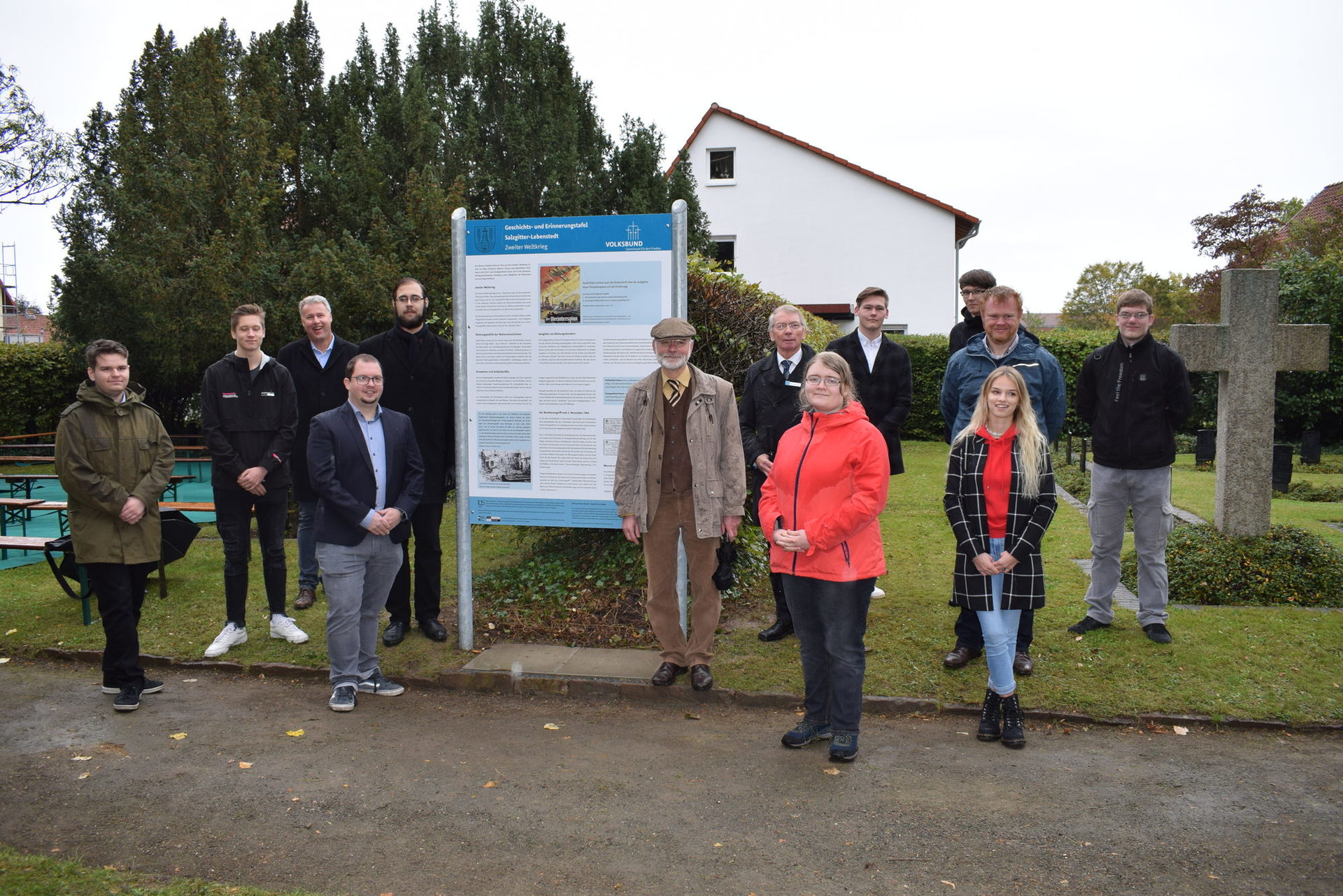
The pupils created this plaque in cooperation with Dr. Rainer Bendick, the education officer of the Volksbund Deutsche Kriegsgräberfürsorge, Bezirksverband Braunschweig, and with the support of the city of Salzgitter. Despite the rainy autumn weather, around 50 guests attended the official handover at the Old Cemetery in Lebenstedt.
On behalf of the city of Salzgitter, city councillor Jan Erik Bohling thanked the pupils for their commitment, who had studied the fates of the 96 dead in their history course in order to find out more about the people and the time. It is impressive that young people are consciously engaging with the city's history and have thus created a lasting symbol of remembrance. This was made possible by Dr. Rainer Bendick, who supported the pupils' work. The educational work of the German War Graves Commission is an important task in keeping alive the memory of war, violence and dictatorship.
This was explained by Walter-Johannes Herrmann, Chairman of the Braunschweig District Association of the German War Graves Commission. Cooperation with schools is important. Remembrance and commemoration are at the heart of the projects. In this way, young people take on responsibility, as the pupils have asked themselves what they can personally do to preserve peace. The answer in the form of this history and remembrance plaque is commendable, because the young people have made a contribution to society.
Hans Jürgen Gatzen, Head of Secondary Level II at IGS Salzgitter, emphasized the political education mission of schools. He said that there should never be war again and that there was no place for racism here. The partnership with the Volksbund Deutscher Kriegsgräberfürsorge (German War Graves Commission) for a new plaque has already been agreed as a further project. The focus will then be on the Franco-Prussian War of 1870/71.
Aaron Heintzen, a pupil at IGS-Salzgitter, reported on the pupils' research work: exploring the cemeteries, visits to the municipal museum Schloss Salder and the city archives were all part of the process to find out more. Despite the circumstances (lockdown, working from home and reorganized lessons), this plaque was created so that the fate and grief of the relatives would not be forgotten. The result is a visible sign of remembrance and commemoration. He thanked the Volksbund, the municipal archives, the municipal museum and the SRB for their support.
 read out