On Youtube: Hannah Klümper "Catcalls, words are also harassment"
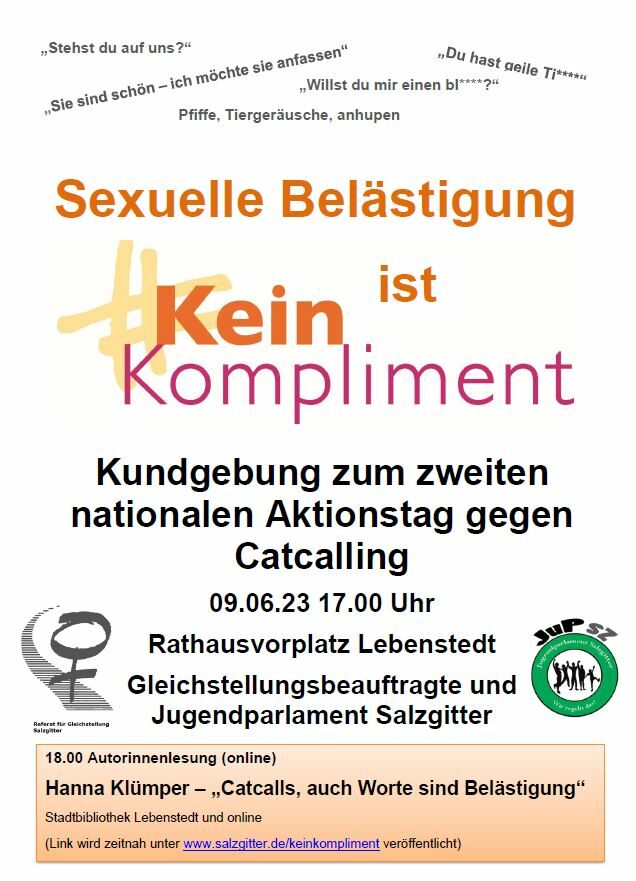
Whistling or kissing noises, cars honking as they drive past, intrusive looks, suggestive remarks on the street such as: "Hey, horny ti**" or "Hey you fo***", "You look good, can I touch you?". These are examples of confrontations that women and girls in Salzgitter had to endure last year. The oldest in her mid-50s, the youngest 10 years old.
"All of this is summarized under the seemingly rather cute term "catcalling". It describes the screaming of cats, which is perceived as annoying. It covers all the different types of sexual harassment without physical contact in public spaces, which are predominantly carried out by men and mainly directed at (especially younger) women," explains Lara Duwe, Chair of the Youth Parliament.
"It ensures that women and girls begin to avoid areas in public spaces and no longer move around in public without fear," Duwe continues. "Those affected in Salzgitter reported," adds Simone Semmler, Equal Opportunities Officer for the city of Salzgitter and initiator of the national anti-catcall day "#keinKompliment", "that they are now taking detours, spending more days working from home because the harassment is taking place on the way to and from work, no longer leaving the house alone in the evening and are simply afraid." Both agree that this is unacceptable.
Although this imposed form of sexuality is not currently a criminal offense or an administrative offense in its own right, it is undoubtedly a form of violence and should also be punished in Germany under Article 40 of the Istanbul Convention.
"We need laws so that this behavior is branded as an unacceptable assault and can be punished at some point," says Semmler. In order to raise awareness, the various catcalling behaviors should be made public in the places where catcalling takes place. This is what various stakeholders, the equal opportunities offices from more than 50 municipalities and districts across Germany, set out to do on the 2nd Action Day. For one year, those affected were able to report their incidents, which were made visible with chalk in public spaces on this day. (Always the 2nd Friday in June, until we have laws).
Here in Salzgitter, the youth parliament and Salzgitter's equal opportunities officer are inviting people to a rally on Friday, June 9, from 5 p.m. on the square in front of the town hall in Lebenstedt, accompanied by music from Alina Ludwig.
"Catcalling is sexual harassment and therefore #keinKompliment", because it reduces those affected to their apparent sexual "availability". Taking a stand against this and making a statement is important and necessary. The aim is not only to raise awareness of the issue, but also to strengthen the civil courage of victims and witnesses," Semmler continues.
After all, it is little consolation that those affected are not alone: 44 percent of women and 32 percent of men in Germany experience situations in which sexist signs and assaults are directed at them. "The well-meaning advice of some men to 'take it as a compliment' doesn't help, because sexual harassment is simply #nocompliment," says Simone Semmler, "It is unacceptable that women and girls in this city and nationwide feel like fair game."
Following the rally, an author reading is planned in the Lebenstedt public library:
