
Concentration camp in Salzgitter
In 1942, the SS and the Reichswerke für Erzbergbau und Eisenhütten "Hermann-Göring" set up the Drütte subcamp. More than 3,000 prisoners from France, Holland, Poland, the Soviet Union and other countries were housed under an elevated road used for operational purposes on the factory premises. They had to produce grenades and bombs in the armaments factories. Further camps were set up in 1944: The Watenstedt/Leinde concentration camp and the Salzgitter-Bad concentration camp.
The Drütte concentration camp memorial
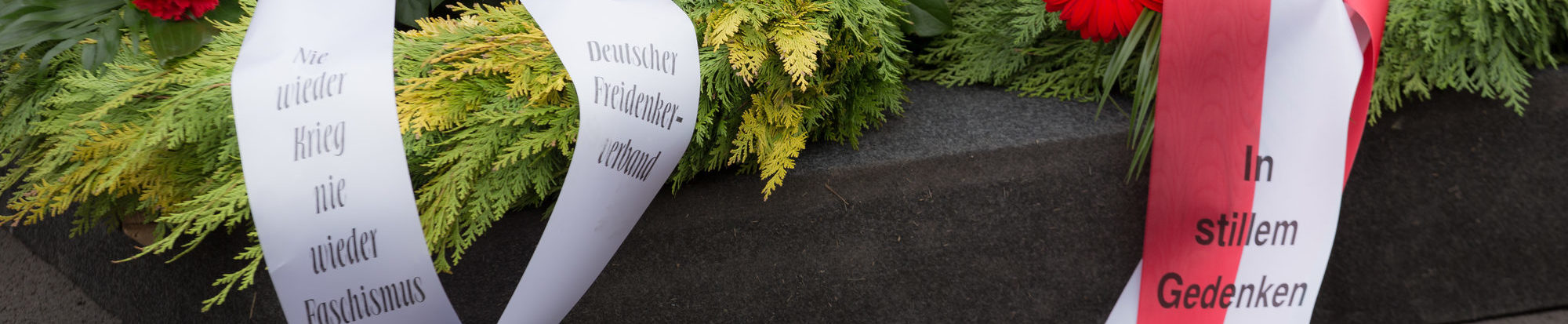
Until the 1980s, the history of the concentration camps in the Salzgitter region was largely suppressed and forgotten. It was only on the occasion of the town's 40th anniversary in 1982 that a public discussion began. In 1983, citizens founded the Arbeitskreis Stadtgeschichte e.V. (City History Working Group). Together with the works council of the steelworks and many other interested parties, the association campaigned for the establishment of a memorial site on the factory premises. On 11 April 1985, the works council organized the first memorial service at the historic site, which has been held annually on the former roll call square ever since. In 1992, the Group made one of the four accommodation rooms available as a memorial. The Drütte Concentration Camp Memorial and Documentation Site was opened on April 11, 1994. It was designed and sponsored by the Arbeitskreis Stadtgeschichte e.V.
The permanent exhibition
At the Drütte Concentration Camp Memorial, visitors can experience history first-hand and engage in a lively debate. The topics of National Socialism, the history of the town of Salzgitter, post-war history and the question of the culture of remembrance can be approached from different perspectives: factual texts, photos and documents provide an introduction to the topic, and statements by former prisoners are an essential part of the exhibition. They give the prisoners names and figures and turn an anonymous mass into people again. Seminar rooms and technical equipment allow for more in-depth study, while an extensive archive and a library complete the offer.
A place for encounters
Events take place regularly in the rooms of the memorial: Exhibitions, readings, theater and music offer a variety of impulses to approach the topic from historical and current perspectives. Due to the special location of the memorial in a working industrial plant, it can generally only be visited by appointment and accompanied by the Arbeitskreis Stadtgeschichte e.V. (City History Working Group).
Arbeitskreis Stadtgeschichte e.V.
Wehrstraße 29
38226 Salzgitter
Tel.: 05341 44581
Fax: 05341 179213
E-mail: infogedenkstaette-salzgitterde
2024: 30 years of the Drütte Concentration Camp Memorial and Documentation Site
"... this is the most beautiful reparation for all those who suffered in Salzgitter ..." (Stane Tušar, 1994) With these words, Stane Tušar, survivor of the Drütte concentration camp, opened the Drütte concentration camp memorial and documentation site at the historic location 30 years ago on April 11, 1994.
Ten years of disputes and resistance preceded the opening, but with the support of civil society and the works council of the then Preussag Stahl AG, the memorial was able to be established: In January 1992, the Arbeitskreis Stadtgeschichte e.V. and Preussag Stahl AG signed a contract for the use of part of the historical premises.
In 2024, the Arbeitskreis Stadtgeschichte e.V. can look back on 30 years of successful memorial site work:
Many survivors of the concentration camps in Salzgitter were present at the opening in 1994 and spoke about their memories of the concentration camp under the Hochstraße at the memorial service on April 11. In addition to these testimonies, close links developed between the survivors and the memorial. These were maintained through their regular visits to Salzgitter, but also through the constant contact between members of the working group.
One year after the memorial opened, Elke Zacharias, who had unfortunately already passed away, became its first full-time director. Since 1996, all new trainees at Salzgitter Flachstahl GmbH (SZFG) have visited the memorial. The first trainee seminar to prepare for the memorial took place in 2000. The SZFG trainees produced 3000 colored steel angles. The colors stood for the different reasons for imprisonment in the concentration camp. The angles were laid out on the former roll call square for the commemoration ceremony and impressively showed the number of people imprisoned there.
With the election of Hasan Cakir to the Works Council in 2006, cooperation between the memorial and Salzgitter AG intensified further. One year later, the memorial was expanded to include two seminar rooms.
This was followed by an expansion of the educational offer: school classes came, youth projects and educational vacations were organized. Since 2010, an annual seminar has been held with SZFG trainees in preparation for the memorial service. In 2013/14, the "HINGESCHAUT?" memorial was created in this context and has made the memorial site visible from afar ever since. The financial basis was also put on a secure footing in 2014 with the conclusion of a contract between the city of Salzgitter, the Lower Saxony Memorials Foundation and the City History Working Group for institutional funding.
The memorial was expanded again in 2019. The "redesign" project began with the newly added 1000 square meters of exhibition space. Since then, the memorial has encompassed the entire former Block IV, the former infirmary and the annex built after 1945. After intensive research, new findings and a lot of work by the memorial team, the memorial's new permanent exhibition was opened on October 18, 2022. The new seminar room was inaugurated six months later. As a result, the number of visitors tripled compared to 2019 to over 3,000 in 2023. The memorial team was also permanently expanded in 2023 to include an educational assistant financed by the SZFG. A position for the archive and another for public relations were filled for 2024.
These achievements were only possible thanks to the tireless work of the survivors, volunteers from the city history working group, volunteers, supporters and, last but not least, colleagues from Salzgitter AG and, in particular, the SZFG works council. The development of the memorial is currently (2024) being shown in an exhibition in the memorial with graphic novel drawings that were created as part of this year's trainee seminar on the commemoration ceremony.
(Text by the City History Working Group: 30 years of the Drütte Concentration Camp Memorial and Documentation Site, 2024)
 read out