
The exhibition focuses on the history of rule in the area north of the Harz Mountains, where the Saxons and Franks met and sought to expand their power. The Franks under Charlemagne were able to incorporate Saxony into the Frankish Empire. The East Frankish Empire developed into the German Empire from the 10th century onwards. Powerful noble families fought for supremacy in the region.
Manors and castles such as Steterburg, Lichtenberg and Gebhardshagen dominated the region and its villages. A true-to-life installation focuses on the life of the knights at Lichtenberg Castle. It was mentioned in written sources in 1180 and was of great importance in the history of the empire until it was destroyed in 1552 and then plundered as a quarry. Many original objects from the mighty fortress are presented in the exhibition.
The exhibition is also about the medieval villages in the Salzgitter region, agriculture, rural crafts and how people, including children, lived and worked. Excavation findings and a reconstruction of the medieval pottery kiln from Gebhardshagen are used to focus on the pottery trade in particular.
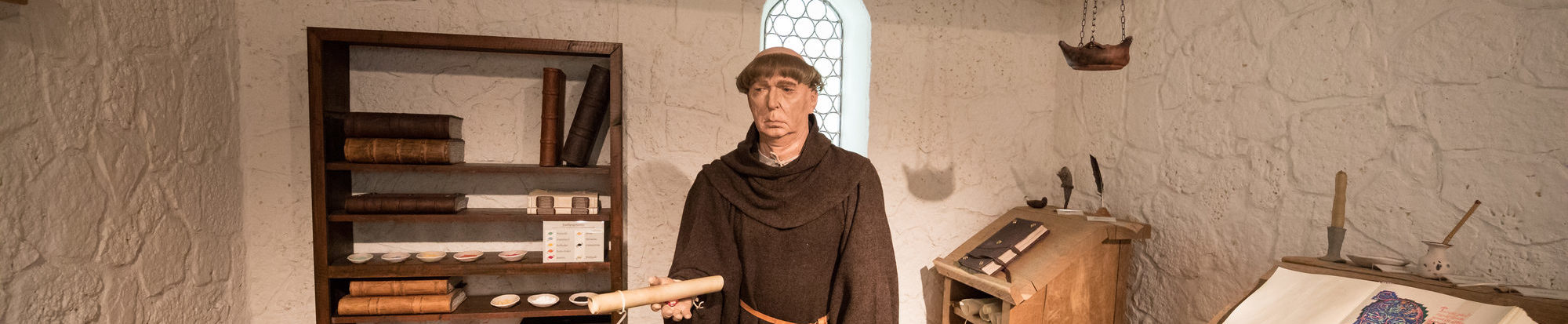
An indispensable part of life in the Middle Ages was faith, Christianity. The Christianization of the Salzgitter region from the 8th century onwards is reflected in many churches and early monasteries and convents such as Ringelheim and Steterburg. The reconstruction of a scriptorium provides a vivid insight into the life and work of the monks in the 12th century. The highlight of the exhibition is the presentation of the late Gothic Kniestedter Altar.
The town of Salzgitter owes its name to the extraction of salt, the white gold of the Middle Ages. A settlement developed around the salt works, which may have had town rights early on. The replica of a salt cottage illustrates the importance of salt for the development of Salzgitter since the Middle Ages.
In the entrance hall of the castle, a large model of the salt town (now Salzgitter-Bad) shows how Salzgitter developed up until the 19th century.
