

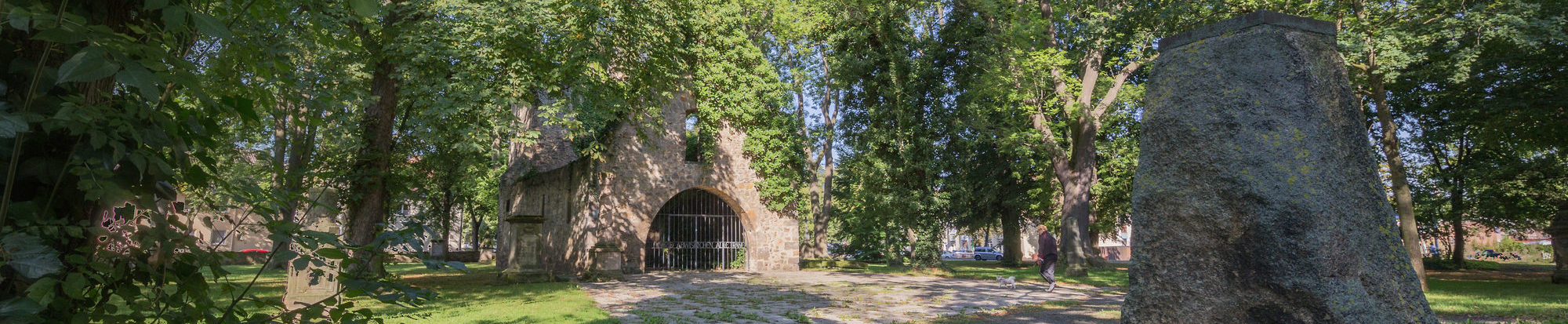

The church of St. James in Vöppstedt, which was first mentioned in documents in the 12th century, formed the core of the old village of Vöppstedt, which must have been much older.
From 1331 onwards, the inhabitants moved to the fortified town of Salzgitter and built St. Mary's Church. The village church, which had become defenceless, was destroyed either in the Beer Feud between 1481 and 1486 or in the Hildesheim Collegiate Feud between 1519 and 1523. In 1591 it was rebuilt as a mortuary chapel and the surrounding village, which had become deserted, was used as a cemetery.
The dead have also been buried in the chapel over the centuries. The church records provide more or less precise information about the members of the patronage and parish families buried in the church, who often had to fight hard for their right to the preferred burial place. The chapel fell into disrepair again during the Thirty Years' War and was not rebuilt until 1683.
May 20, 1807 was probably the most radical change in the use of the building, when the French city commander La Chaise ordered the superintendent Feyerabend to clear all the furnishings from the chapel within one day to make room for the prisoners taken by the French army. Thus, during the French occupation, the church became both a prison and a food store.
In the following years, it was even considered demolishing the chapel in order to renovate the St. Marie-Jakobi church in Salzgitter with the proceeds from the sale of the building materials. However, this did not happen, which did not stop the further deterioration of the chapel. In 1863, the tower roof collapsed and in 1924, the roof of the nave had to be removed for safety reasons.
Around 1900, the brickwork of the arch on the east side of the nave collapsed, exposing the opening that can be seen as the separation between the nave and a presumed chancel as the eastern end, which is not documented in the chapel's literature.
Over the years up to 1940, the condition of the building deteriorated to such an extent that it had to be cordoned off. It was not until after 1960 that the Salzgitter town council decided to convert the cemetery and chapel into a park-like memorial for the victims of the two world wars and tyranny, and to secure the ruins of the chapel in a manner befitting a historical monument. After 1980, a memorial plaque was erected for victims of the Hannoversche Treue mining accident.
In 1886, the Protestant old town cemetery was established and the number of burials in the Vöppstedt cemetery steadily declined until the last burial in a family grave probably took place in 1920. Today, only a few monuments and a mausoleum bear witness to the people who populated Salzgitter.