We also presented a joint open letter to the responsible federal and state ministers, the state premiers and the rapporteurs of the parliamentary groups in the German Bundestag.
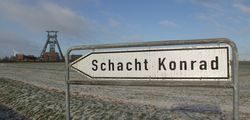
The concept and the long-term safety case for the Konrad mine are now decades old. The experience gained from the failure of Asse II was never taken into account.
While the law for new repositories now requires the waste to be recoverable within 500 years, this is neither planned nor feasible for Konrad.
Frank Klingebiel, Mayor of the City of Salzgitter: "It is therefore no more than right and proper to at least demand a reassessment of the Konrad project according to the state of the art in science and technology. Safety and health protection for the people living here have the highest priority for me and those responsible in the city of Salzgitter. It is therefore unreasonable that a project with such long-term effects as a nuclear waste repository should simply continue to be built, even though there are major doubts about its feasibility and safety. Precisely because the Federal Constitutional Court has denied local authorities and citizens the right to take legal action for environmental protection, we believe it is all the more important to demand this politically now. Experience from Asse II must be taken into account."
On behalf of Landvolk Braunschweiger Land, Ulrich Löhr, who has his farm in the district of Wolfenbüttel, explains: "After the disastrous experiences at Asse II, it is essential that nuclear waste must be stored near the surface and retrievable in future. The Landvolk played a major role in the lawsuit brought by the Traube farming family from Salzgitter against Konrad, which was rejected by the highest court in 2007. An appeal is currently still pending before the European Court of Human Rights. Site conditions in Salzgitter and transportation were never taken into account

On behalf of IG Metall Salzgitter-Peine, Björn Harmening points out that the clarification of central issues such as a balanced consideration of the site conditions and the transports on federal orders should not be clarified in the Konrad proceedings: "IG Metall is still of the opinion that it is irresponsible to construct a nuclear repository in the immediate vicinity of thousands of workplaces. The storage shaft II on the Salzgitter AG site is located in the immediate vicinity of hot operations such as the blast furnaces and the rolling mill. Ignoring the associated accident risks, the transports are nevertheless to roll through the densely populated urban area every day by rail and truck."
Problems at Konrad bigger than previously assumed? Since 2000, there have been several actions against the Konrad project and nuclear policy during working hours at metalworking companies in the region. "This is not just about the interests of a single site," adds Ursula Schönberger, lead author of the first comprehensive "Nuclear waste inventory for the Federal Republic of Germany". "It's also about the retrieval waste from Asse II, uranium waste from Gronau or the legacy of the Jülich research center, none of which could be stored in Konrad anyway, and it's about the interests of all sites that are still being promised that the waste there will soon flow to Konrad."
Schönberger also believes that the problems with the realization of Konrad are greater than previously assumed. A presentation on the remediation of the Konrad shafts at a specialist event on March 20 was canceled because it "was simply not approved". And one thing is certain: "If the shafts of the old Konrad facility cannot be refurbished, they will have to be rebuilt and, of course, the operator knows that a new facility would also have to be re-approved."