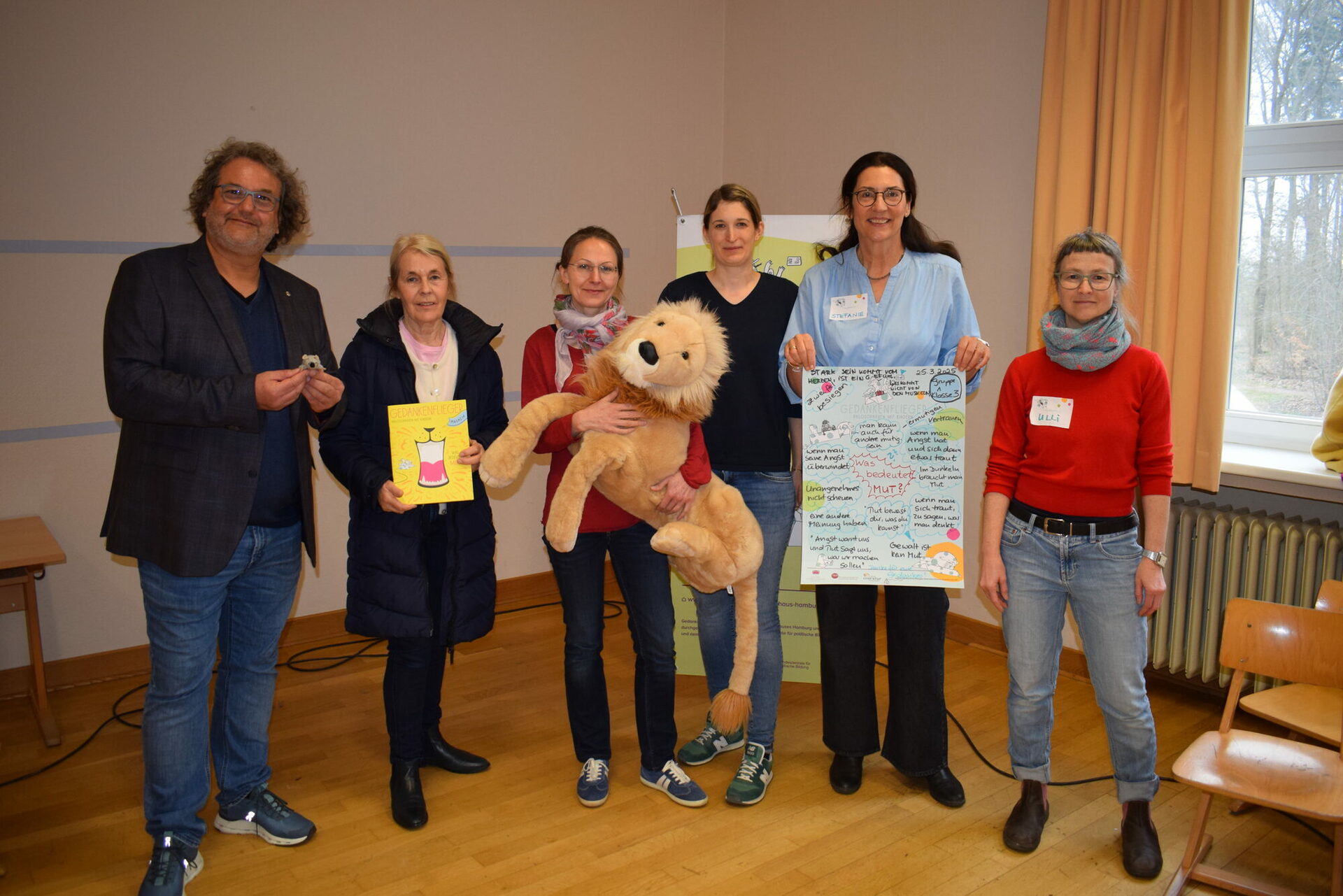
The "Gedankenflieger - Philosophieren mit Kindern" initiative of the "Junges Literaturhaus Hamburg" visited several elementary school in Salzgitter again this year to show the children in the 3rd and 4th grades there what the big questions of philosophy have to do with their own lives. This time, the elementary school Am Ostertal in Lebenstedt with its branch in Salder, the elementary school Lichtenberg and the elementary school Steterburg in Thiede took part.
Two speakers from the Literaturhaus visited each of the schools and let their thoughts fly with the pupils in a playful way - a total of eight morning events were on the program this year. Based on carefully selected picture book stories, the topic "What does courage mean?" was discussed and reflected on together. Reasons and connections were sought, supposedly self-evident things were examined and the children were able to gather their own experiences and ideas on this central question. It was not uncommon for them to find consensus, exchange opinions, formulate arguments and listen to each other's views. This was done creatively, playfully, in an age-appropriate way and always using the books brought along by the speakers and the "Gedankenflieger" magazine, which was specially developed for the topic and which accompanied the events, deepened them and encouraged the children to record their thoughts and continue thinking about the ideas they had set.
This time, the "Gedankenflieger on tour" in Salzgitter was financially supported by the Lions Club Salzgitter (LIONSZ) and (as several times before) by the Federal Agency for Civic Education.
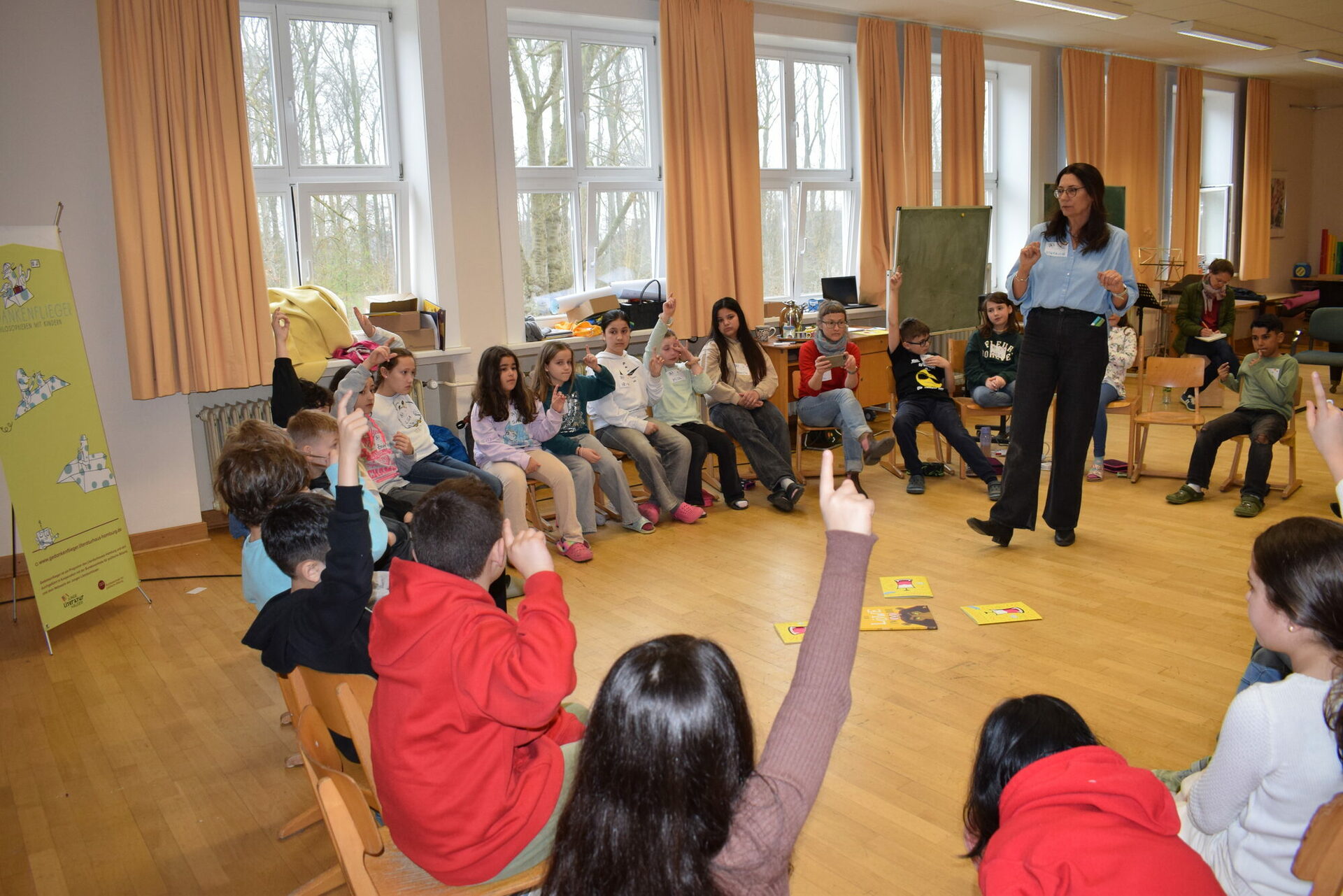
The 3b of the Steterburg elementary school with us
Stefanie Segatz and Ulrike Jänichen supported the children in philosophizing in class 3b at Steterburg elementary school. It was important to the two speakers that the pupils were able to express their own thoughts without being judged. Every idea was welcome and so it was the pupils who shaped the event. "Here the children can experience what is unfortunately often neglected nowadays: Their thoughts are given serious consideration without being judged straight away," said Segatz, explaining the idea behind the project. Jänichen added: "We are also practicing early political education. Democratic skills are developed in this way. We exchange ideas at eye level: 'You think this and you think differently and that's okay'".
The pupils in class 3b had very different answers to the question "What does courage mean". Many of them were quite unusual and probably wouldn't have occurred to everyone on the subject straight away. For example: "Courage is when you can say no"; "When you overcome your fear". But the children agreed: "Fear is necessary to have courage". When asked by the speakers what helps them to be courageous, the answers included: "Thinking good thoughts, like 'I can do it'"; "Believing in yourself"; "When you prepare well for a task"; but also "When others believe in you and support you". However, many of the pupils were also surprised when their classmates said that they thought they were particularly brave. They were praised for standing up for their ideas, speaking their mind freely or having protected a classmate from a stronger girl or boy.
After the exchange of ideas, the children looked at the picture books brought along by the speakers. But first the children were asked who they thought was the bravest, a lion or a mouse. Contrary to what Stefanie Segatz and Ulrike Jänichen had expected, two almost equally large parties formed in the class. One said that the mouse was braver than the lion, and the other thought the big cat was braver. After working with the picture books, a completely different picture emerged. Now most of the pupils were certain: "The mouse is the braver one".
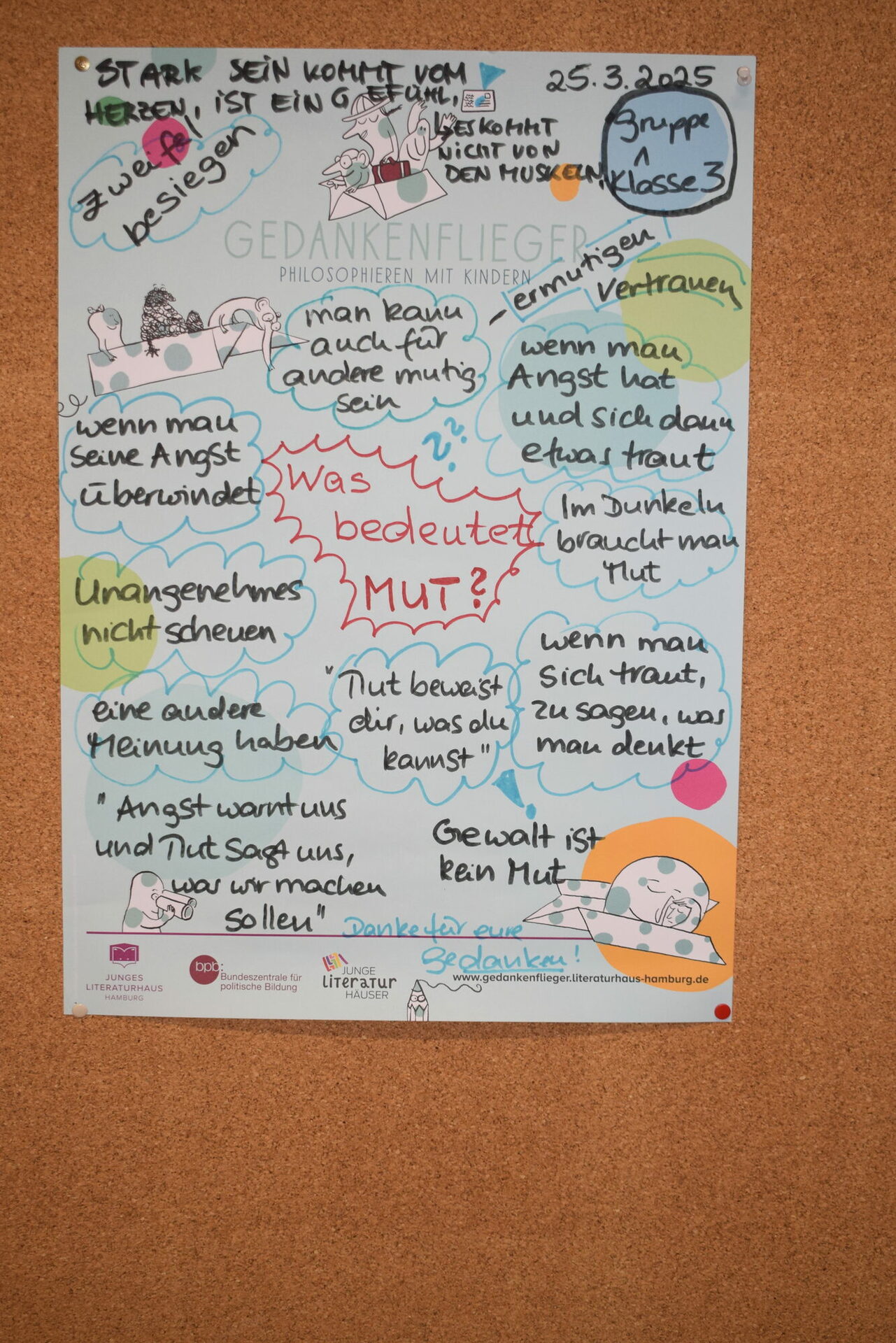
What do and who are the Gedankenflieger?
"Gedankenflieger" encourages children to ask what kind of world they want to live in. What are the values that hold our society together?
With Gedankenflieger, children encounter the big questions of life in the protected world of picture books. They train social skills and learn to face the challenges of our time with creativity and self-confidence. In this way, free thinking provides orientation in an ever faster changing world and possibly opens up visions of a successful future that is worth working for.
Gedankenflieger is an initiative of the Junges Literaturhaus Hamburg and is organized in cooperation with the Federal Agency for Civic Education/bpb and the network of literature houses.
For six years in a row (since 2020), the Gedankenflieger speakers from the Literaturhaus - arranged by the Literaturbüro in the City of Salzgitter's Department of Culture - have packed their suitcases and set off on a multi-day overland tour to Salzgitter.
With their "Philomobil" (a minibus equipped with good books and ideas), they visited various elementary school in Salzgitter, philosophized with primary school pupils of different grades and were surprised and inspired by the ingenuity and imagination of the participating children.
In addition to the carefully thought-out concept and the great commitment of the speakers, it is also thanks to the financial support of various sponsors here in Salzgitter and from the region that this was so wonderfully successful. It was not least their generous contribution that made it possible for the Gedankenflieger project to be offered free of charge by the participating schools and to establish continuity in Salzgitter.
