

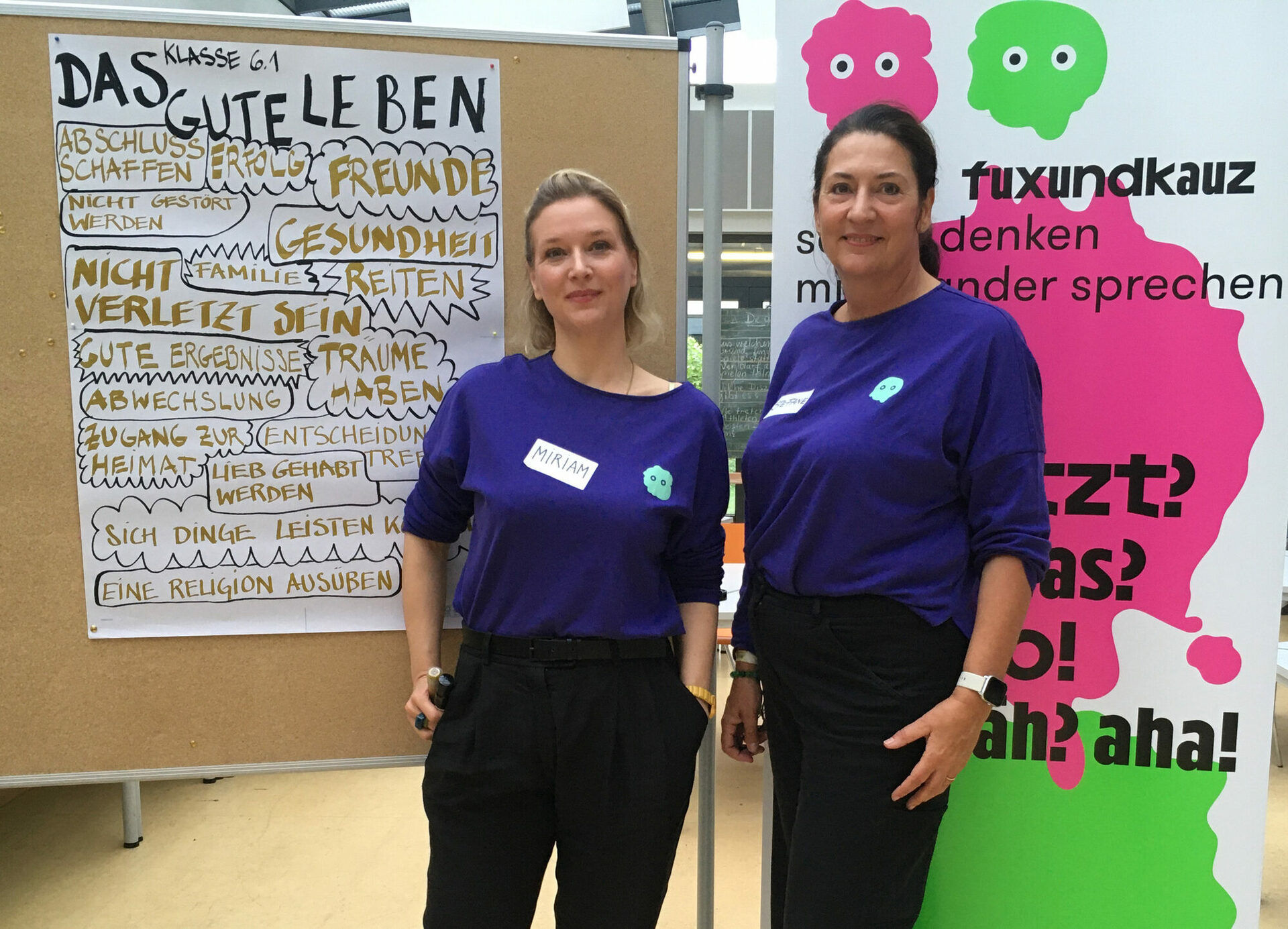
They were joined by "fuxundkauz" project founders Miriam Holzapfel and Stefanie Segatz, who, equipped with lots of ideas, thoughts and questions, a flipchart and not least the project's own colorfully designed magazine "filofux", were very excited to see how the children would take to their "thinking workshops" and what they would develop from them.
The two speakers wanted to get the children thinking about fundamental philosophical questions such as "Who are you?" for Year 5 and "What is part of a good life?" for Year 6 in a playful way and in joint discussions with the pupils.
When Miriam Holzapfel and Stefanie Segatz arrived at Emil-Langen-Realschule in Lebenstedt, a special week of events began for them too: the two speakers were greeted happily and excitedly in the corridors by several children: no wonder, as they still had fond memories of "fuxundkauz" from their last visit to their school last fall.
In the 5th grades:
First, the children sat down in a circle of chairs in the light-flooded multifunctional room in the middle of the school building - ideal for the upcoming discussion format, in which everyone was not only supposed to listen to each other as well as possible, but also see each other and communicate freely with each other.
The children quickly found out how much fun this is and how it can help them get to know each other and discover some of the things they have in common. They started right away with a game in which they all had to stand up again and - volunteers in front! - to lend their intuition and their perceptions of themselves and others the floor and, together with the answers of their classmates, check for possible correspondences or deviations. "Give this card to a person you don't know what they do in their free time" was one of the tasks and helped them to find out a bit more about each other or discover shared hobbies (often soccer) in the next step.
Things got a little more difficult when the children were asked to "Give this card to someone you can imagine what they might be like as an adult".
The children took their time to think about who they thought the respective card might apply to. However, the game was not only used to find out more about each other, but also as a first introduction to the discussion about what basically "defines" a person or can describe their personality.
The result: after the first part of this "unscheduled" school lesson, there was no longer a blank page on the board, but a full summary of the children's personal "thinking workshop", which included elements as diverse as "what you want to be", "feelings", "family", "talent", "friends", "behavior (towards others)", "language", "soul", "body", "goals", "intelligence" and "character".
In the second part, the pupils had the opportunity to write and draw individually or in groups in the "filofux" magazine, which approached the initial topic again with new questions or thought tasks. Here, too, it was important to listen carefully to oneself. While the pupils leafed through the colorful pages, they also had the opportunity to talk to Miriam Holzapfel and Stefanie Segatz about their specific answers or reflections in their personal "filofux" magazine.
When the children were finally asked why they thought it was important "that we know each other better", they came up with surprisingly clear answers such as: "So that we know our boundaries" or "So that we know how the other person wants to be treated".
In the 6th grade:
Most of the sixth graders had already thought about the concept of "identity" with fuxundkauz last fall. This time, they focused on a different, no less multifaceted topic: "The good life".
To warm up, they were first allowed to make assumptions about the lives of the others present. They had to think about why they assume that someone has a good life - and, above all, why.
One pupil was a little surprised, but on closer inspection was in complete agreement, when she received a card: she was perceived as someone who can admit mistakes. Yes, that's true, she explained; she often finds it difficult, but she does it anyway. Her classmates were able to understand very well that she finds it easier to admit mistakes with friends.
Answering the question of whether they thought something like "effort" was also important for a good life proved to be not so easy. In the end, the students opted for a "both/and" answer: if you are successful, then effort is good, but if not, then not. At this point in the discussion, however, the students had already arrived at the next impulse and game round, which Stefanie Segatz and Miriam Holzapfel had prepared and tested in practice for the first time: In the middle of the circle of chairs, there were several cards face down on the floor, labeled on the underside, one of which was revealed by a child each round and read out loud: "Is the term drawn - with a view to a good life - relevant to me? What does my environment think about it and what importance do I attach to it?" At the end of each round, the card holder could decide whether the card should be put aside as less important, removed from the game completely or placed face up among the other cards. "Friendship" was very important to almost all of the children, but the term "family" seemed even more significant. It resonates with the feeling of trust and connection, and the family also teaches you important basics and "you get a lot of love from them".
Here too, the Year 6 pupils were given the opportunity to work alone or in small groups with the thematically appropriate leaflets that the speakers had designed and brought along for this thinking workshop. There was plenty of space on the (unfolded) Din A3 sheets to record their own ideas about what a good life could include in words or pictures.
Background:
Following the very positive response last year, the project with a total of eight philosophical thinking workshops was able to take place again in 2024 thanks to the successful collaboration between Emil-Langen-Realschule, the participating teachers, the literature office in the city's specialist cultural service and the founders of "fuxundkauz", Miriam Holzapfel and Stefanie Segatz, as well as the Federal Agency for Civic Education, which provided financial support for this series of events.
