

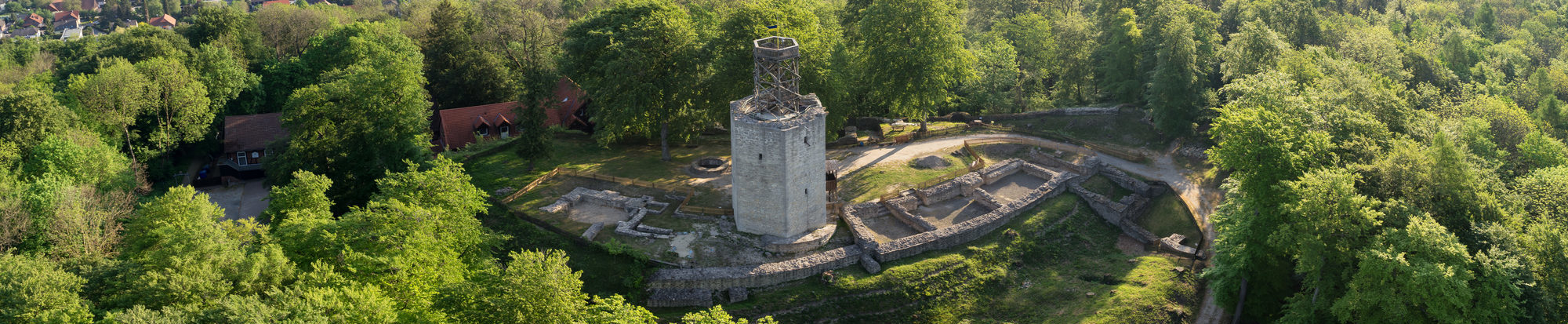

Archaeological excavations, particularly in 1902, 1957 and the investigations carried out by the Salzgitter Archaeological Working Group from 1990 to the present day, have uncovered and preserved the remains of the walls of the extensive castle complex, which was used as a building material supplier until around 1860, and depicted them in plans
On the basis of finds such as shards, coins, plaster and wall remains, experts were able to interpret the age and in some cases the functions of the various building elements of the castle.
The complex, which was inhabited by bailiffs and castellans with their retinue, also had a space for silence, devotion and inner contemplation. The castle chapel was located during the first explorations. Remains of frescoed and gilded plaster, which point to the Romanesque period, as well as lead rods and painted glass were found in the castle moat directly next to the gatehouse to the east of the main castle, indicating the presence of a chapel. Other finds include a scallop shell, the pilgrim mark of the Spanish pilgrimage site of Santiago de Compostella and the remains of the bronze bell that called people to church.
In the course of investigations into the restoration of the walls of the core castle in 2002, the building fabric was completely uncovered in the area presumed to be the castle chapel. This uncovered the remains of a barrel vault in the basement, which was subsequently inserted into the outer wall. This vaulted cellar was probably used as a storage room. The castle chapel was probably located above this vaulted cellar. Contrary to earlier speculation, there is no trace of human remains that could indicate a burial in this area.
There is evidence of a chapel in the castle chapel, first mentioned in 1290, in 1542. In a visitation protocol, which was first drawn up at the instigation of the Schmalkaldic League for the introduction of the Reformation in the Principality of Braunschweig-Wolfenbüttel, it is stated about the then parish priest for Oberfreden, which lies on the hillside below the castle, Johannes Issmann, that without the care of the chapel at Lichtenberg Castle, which was then destroyed in 1552, he would suffer economic hardship. Later, Pastor Issmann was pastor in Oberfreden, Niederfreden and Salder.
Author: Karlhans Kummer (Friends of Lichtenberg Castle) 2007