

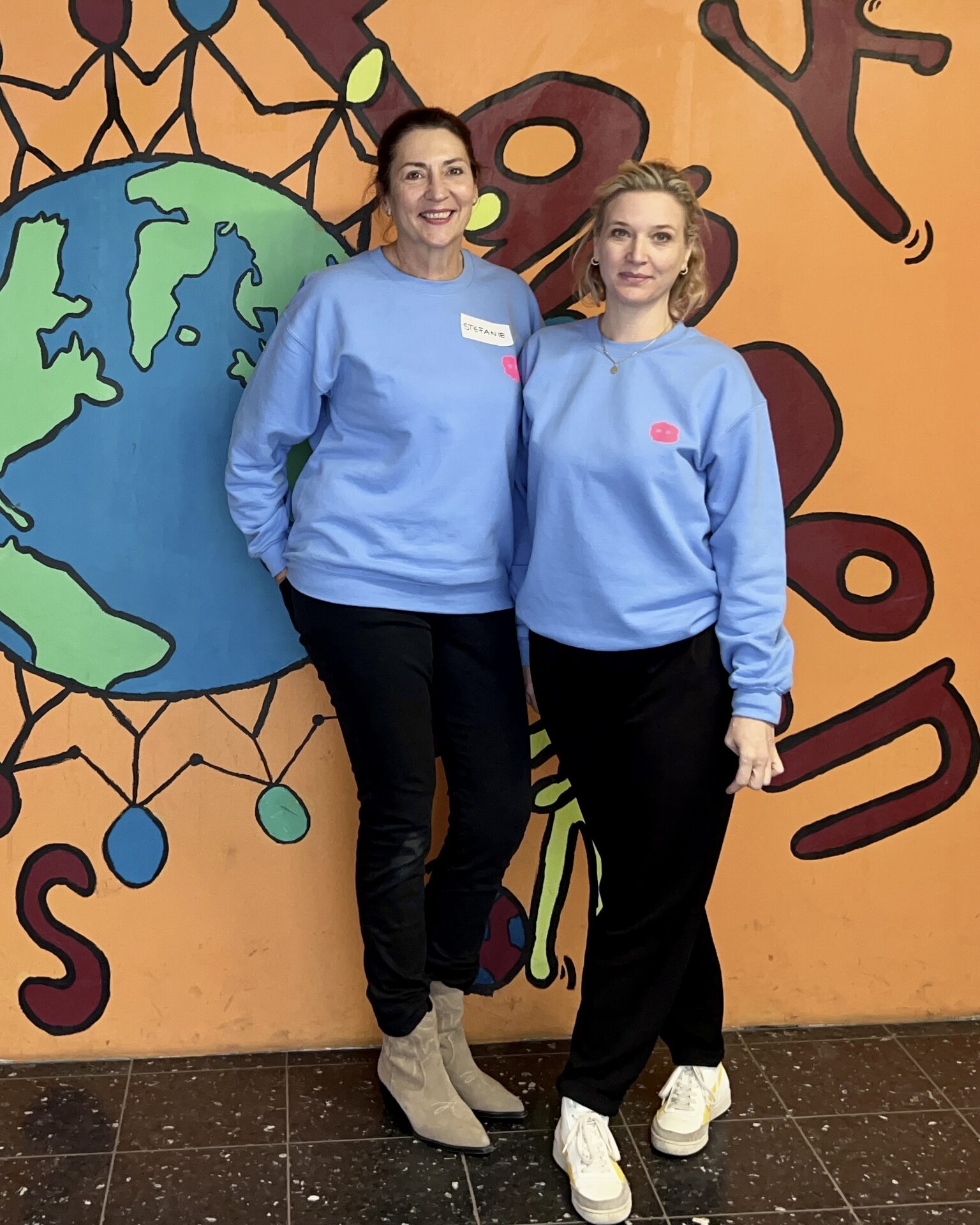
The fact that "fuxundkauz" say "good morning" to each other (and their young fellow thinkers) at Emil-Langen-Realschule has already become a small tradition. In 2023, the founders of the project of the same name for children and young people, Miriam Holzapfel and Stefanie Segatz, were guests for the first time to spend four mornings with pupils in Years 5 and 6 thinking about the questions "Who are you?" and possible ingredients for "The good life".
Based on a philosophical question, the focus of these "thinking workshops" is to explore together what connects us and how we can deal with different opinions and experiences. How can we talk and listen to each other in an appreciative way, and what does it mean to think for ourselves and therefore independently?
The moderated and playfully introduced discussions focus on the ideas, considerations, essential questions and ideas of the children themselves. That's why there are no "wrong" answers, but rather interested questions about arguments and experiences. Beyond the pressure to perform and in an inviting way, "fuxundkauz" encourages each and every individual in the group to listen to themselves, to put their own feelings and thoughts into words and to share them with the others.
After all, recognizing who you are and what is part of a good life for you personally requires both: listening outwards and listening inwards, interested conversation and enduring question marks and pauses in speech. It can take courage to express your own opinion or to admit that you are still unsure. It often takes patience to become clear about your own views or to wait until someone else has made themselves understood. Above all, however, the pupils learn during these mornings that their ideas of a good life and their associated wishes are surprisingly similar in many ways.
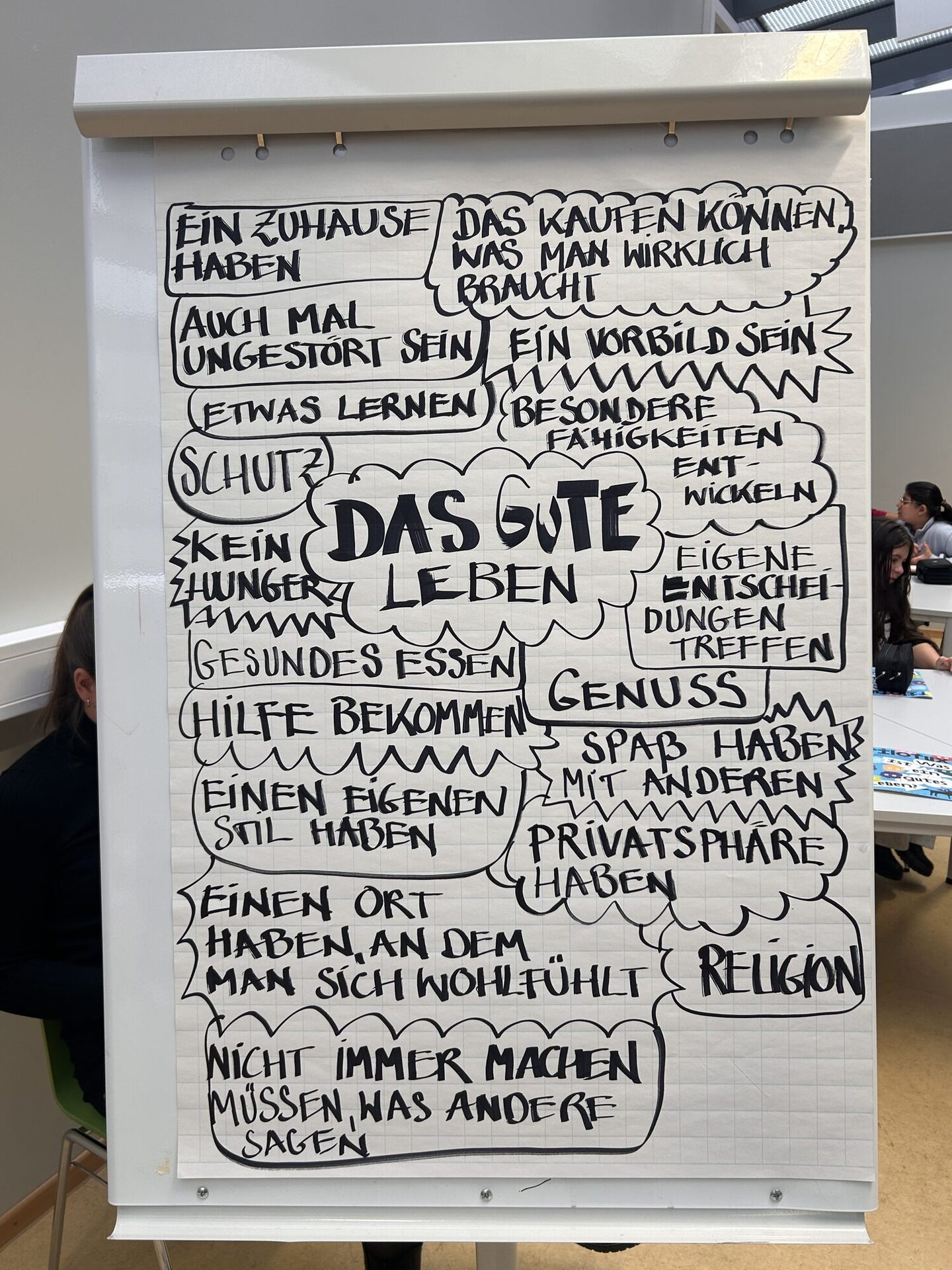
This is already evident when collecting and collating the terms that, for the Year 6 pupils, are significantly linked to their idea of a good life. Using cards that are initially face down and spread out on the floor, the group discusses during several rounds of the game how important they consider "food" or "freedom", for example, in terms of the possibility of a good life. If nutrition is primarily important so that people do not go hungry and because children need good food to grow, it is ultimately also about "feeling good in your body". On the other hand, there are always situations - one pupil adds - in which some people are treated worse because their bodies do not correspond to the expectations of others. On closer inspection, it becomes clear that hardly any of the concepts raised are satisfied with clear answers; they are always shaped by context and perspective.
Even when it comes to "freedom", which basically seems desirable for everyone and is a prerequisite for developing without fear or need, the students differentiate. Being able to make their own decisions is a good thing - going out, meeting friends and eating ice cream, for example. Freedom can also increase as you get older, but this also brings with it greater responsibility. This is true, for example, says one pupil, when you look after your younger siblings. For her, this is a task that she is very happy to take on, but at the same time she also hears her father's well-meaning advice that you shouldn't forget to take time for yourself. And then every freedom has certain restrictions, which can possibly be useful after all, the group ponders further. For some, "having to" go to school is one of them. One boy talks about the rules that are imposed by his or her religion or religious practice. For him, it is quite clear that this can still be okay, because it is up to you to decide whether you want to live according to this religion. In our Basic Law, "fuxundkauz" reminds us on this occasion, there is even a separate term for this: "freedom of religion".
However, there are a whole range of other concept cards waiting to be drawn and then discussed. These include terms as diverse as "home" and "money", as well as "movement", "security" and "fun". A joker has also been added, allowing the pupils to come up with their own favorites. Each child who has turned over a card and read it out is first allowed to cast their own vote. When one pupil explains why "family" is so important to him for the card he has drawn, the others can understand his reasons very well: family is so important to him because it looks after you and protects you, because it is "forever" and can therefore - at least that's what you can guess between the lines - convey a feeling of reliability, trust and security. But there is also a caveat, the student remembers, because of course not everyone has a nice family. In such cases, "friendships" can be a great help. A point that is also very important to the students. Of course, this doesn't just apply in times of crisis, because the great thing about friends is that you can have fun with them, just walk around the neighborhood and enjoy hobbies together. Not being alone therefore plays a major role for most children, even if, as one pupil points out, there can sometimes be "false friends" as well as "good friends". This requires their own judgment and enough self-confidence to avoid negative influences as much as possible.
Thinking so intensively about such a big topic can be quite demanding and takes time. And of course, 90 minutes is not enough to deal with the question of the "good life" even halfway exhaustively. But the important impulse to think further and share experiences is there. Thinking never stops anyway, and just when you think you have an answer, the next puzzle is bound to pop up - this can be a surprisingly motivating and satisfying experience. The "The good life" poster, which is now full to the brim, remains in the classroom and also motivates teachers to follow up on this thinking workshop.
After a short break, the workshop usually continues directly with the Filofux magazine, which the speakers have developed especially for this event format. For class 6.4 and class 6.1, however, Stefanie Segatz and Miriam Holzapfel have come up with a small addition for the third "fuxundkauz" morning - because we can also find material, points of reference and inspiration for many current issues in stories and even very old fairy tales. And the Brothers Grimm fairy tale "Of the Fisherman and his Wife" seems to be perfect for a further, more in-depth perspective on the question of what we think we need for a good life. Miriam Holzapfel retells the main stages of the story for the pupils without having to discuss the unspoken question of what they would have wished for from the enchanted fish in the circle of chairs. The pupils should now simply take their very own wishes and thoughts to the tables, where they can turn to the green page of their Filofux magazine and get creative in silence or together with their table neighbors, either by writing or drawing. This is also a valuable part of this workshop because it gives the teachers the opportunity to talk to individual pupils or smaller groups again and have the children explain their very specific ideas and considerations using the tasks in the magazine.
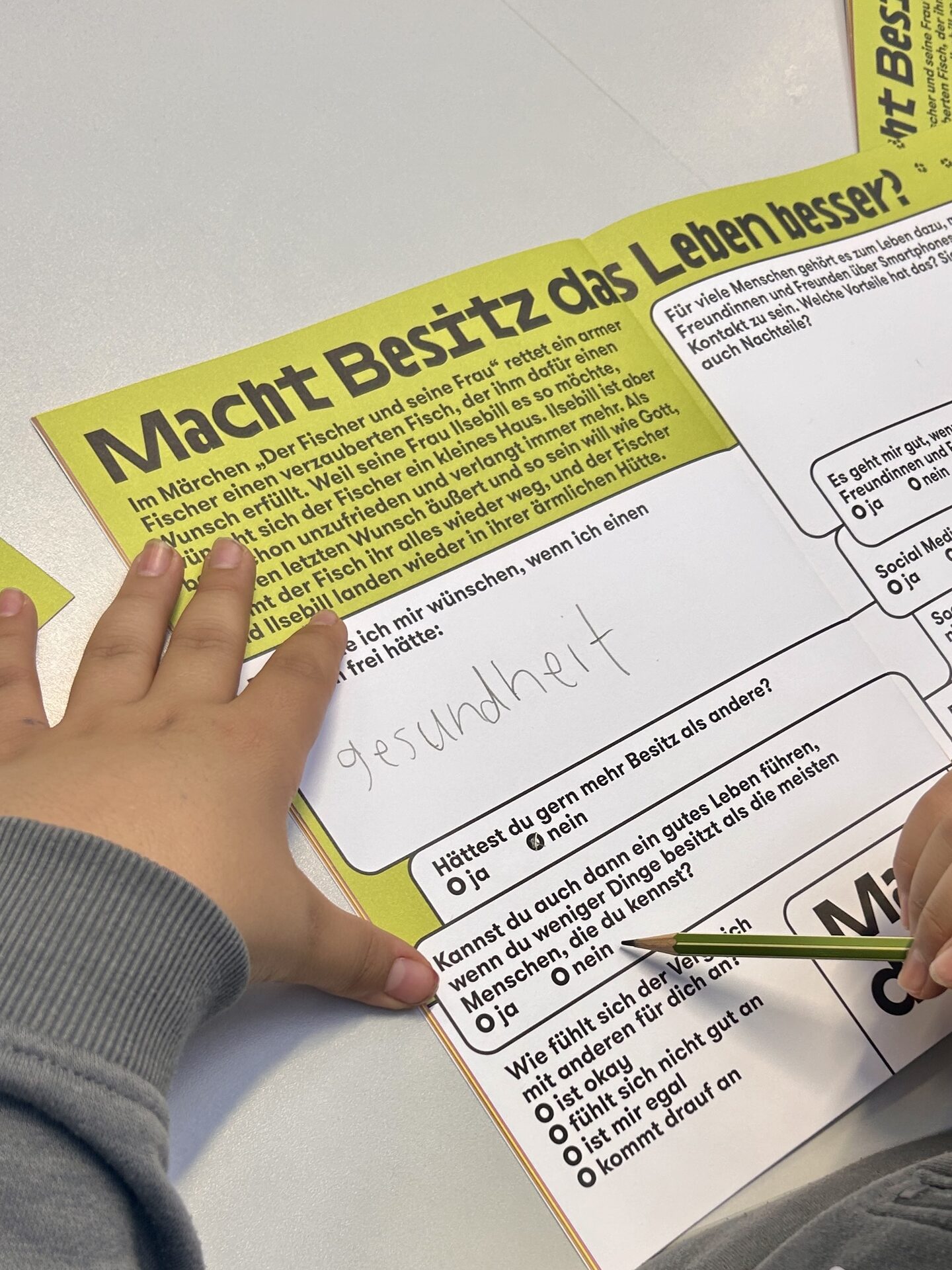
And then this "thinking workshop" is over again - but not without a short final round in which the pupils can present a selection of their personal Filofux articles and comments, time permitting. Miriam Holzapfel and Stefanie Segatz bid farewell to the children with a heartfelt thank you for their thoughts and best wishes for a good life. And even if nothing has been decided yet, it is clear to everyone involved: It would be great if they could meet again next year for a new "thinking workshop". One pupil asked "fuxundkauz" on one of the mornings whether "you will be coming here again". We would all be very happy about that!
Thanks for four inspiring mornings to all those involved - the pupils of the 5th and 6th grade of the Emil-Langen-Realschule, all the teachers involved, the Federal Agency for Civic Education, which so generously supported the project financially, and, "last but (surely) not least": Miriam Holzapfel and Stefanie Segatz alias "fux" and "kauz"!
