

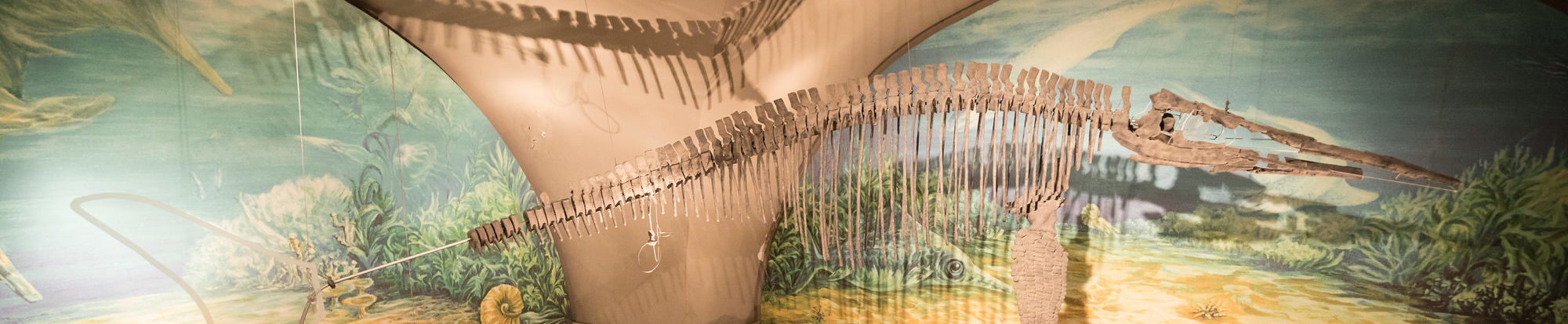

The ichthyosaur
The seas of the Mesozoic Era were populated by various groups of large marine reptiles, also known as marine dinosaurs. The marine dinosaurs most adapted to life in the water were the ichthyosaurs, which are known from the Lower Triassic (Triassic: 250 - 200 million years ago).
Their name comes from their fish-like shape; the head with its long pointed snout sits on a spindle-shaped body that ended in a large crescent-shaped tail fin, as is also known from sharks and dolphins.
The legs of the ichthyosaurs were completely transformed into fins, which were only used for steering, but not for propulsion. The structure of the fins and the entire skeleton clearly show that ichthyosaurs were no longer capable of walking on land. As they became viviparous early on in their evolution, there was no longer any need to leave the water to lay eggs. This meant that all the prerequisites for the optimal adaptation of their body shape to aquatic life were met.
Ichthyosaurs ranged from dolphin to whale size, the smallest forms were not much longer than one meter, the largest well over 20 meters, as evidenced by a skull over 4 meters long from the Upper Triassic of Canada. The diet of the smaller forms consisted of fish and squid, as fossil stomach contents show. The larger forms, such as the Platypterygius from Salzgitter, probably lived a predatory life and preyed on smaller marine dinosaurs, including smaller ichthyosaurs.

Platypterygius has a total length of about 4 to 7 meters with an elongated, wedge-shaped skull with relatively small eyes and strong teeth. The genus Platypterygius is not only the last surviving form of ichthyosaur, but also the one that lived the longest (50 million years). Various species of this genus have been found worldwide during this period, as evidenced by finds from Australia, Europe, India, South and North America.
There are repeated finds from the Cretaceous in northern Germany, although these usually only consist of parts of the spine or teeth. The find from Salzgitter was originally complete, but some parts were lost or destroyed during excavation and later uncovering from the rock. Nevertheless, the overall shape can be reconstructed quite accurately by comparing it with other finds. The skeleton has a total length of around 5 meters. The rather short trunk region and the very small hind fins are striking. The skeleton is one of the most complete finds of Platypterygius and forms the basis of the species Platypterygius hercynicus.
The find comes from layers of the Apt and is probably around 115 million years old. Through Johannes Weigelt, Professor of Palaeontology at the University of Halle, who had been employed as a geologist at the Reichswerke since 1937/38, the specimen entered the collection there and was further uncovered by Oskar Kuhn shortly afterwards and described in a scientific publication in 1946 and named as Platypterygius hercynicus and thus as a new species.
New investigations (Kolb 2006) confirm that this find is indeed a new species.
 read out