Preparation of a double budget
The administration is presenting a joint budget for the 2021 and 2022 financial years, as planning for two years has proven successful. In accordance with Section 112 (3) sentence 2 of the NKomVG, the budget statutes contain separate budgets for two financial years.
Annual financial statements 2019
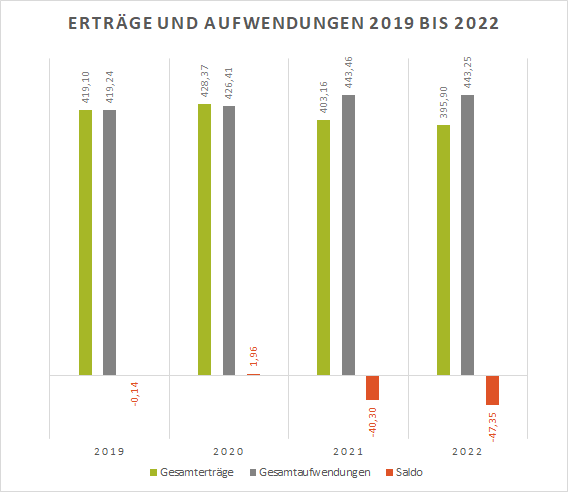
The annual result for 2019 closes with a small deficit of EUR 140,000. The structural shortfall originally planned in the 2019 budget for 2019 was largely offset by the administration's own consolidation measures in implementation and a state requirement allocation of € 5 million. of EUR 5 million from the planned EUR -1.054 million by EUR 0.914 million to EUR -0.14 million.
Forecast 2020
In particular, the observation of the development of tax revenue and unscheduled value adjustments mean that the 2020 forecast is expected to fall short of the planning assumptions and the 1st addendum. This leads to the simultaneous submission of the 2nd supplementary budget bylaws 2020. Further overruns in various budgets are largely offset by budget surpluses in other organizational units. A corresponding forecast as at 31.07.2020 can be found in the consultation documents. Further management progress will be monitored. For 2020 itself, the overall result is expected to improve due to the compensation payments from the state. Due to the Covid-19 pandemic, a central budget of EUR 350,000 will be set up in 2020. This will provide the administration with, among other things, spit protection walls, disinfectants and masks as well as security services. The costs incurred are covered by the cover reserve.
The financial year 2020 will turn the originally planned shortfall of € -15.40 million into a surplus of € +6.94 million thanks to an improvement of € 22.3 million as a result of the 2nd supplementary budget 2020. The positive result of EUR +6.94 million in the 2020 financial year should not obscure the fact that the budget and financial situation in the following financial years 2021 to 2025 will be characterized by considerable deficits as a result of a drastic drop in trade tax income. The additional annual deficits in the double-digit million range will dramatically restrict the city's own ability to act in the coming years. It should be noted at this point that this catastrophic financial development is solely due to the sharp drop in trade tax and income tax and is therefore not home-grown, but externally determined. This catastrophic development is due to the coronavirus pandemic and its economic consequences for businesses in Salzgitter as well as the effects of the correct and necessary transformation processes of companies towards climate-neutral production processes. The city of Salzgitter - like other cities, municipalities and districts in Lower Saxony - will only be able to overcome this financial downturn, for which the city of Salzgitter is not responsible, with further financial support measures from the federal and state governments. The latter also have a duty not to leave their municipalities, which are successfully implementing the coronavirus pandemic and the state's climate neutrality target locally, out in the cold.
Budget planning 2021/2022
The 2021 contribution budget closes with a deficit of €47.77 million in the income budget. Compared to the value of the medium-term planning of the 2019/2020 budget, which still assumed a planned deficit of €4.50 million for the planning year 2021, this represents a further deterioration of around €43.28 million. This is due to the fact that trade tax income fell significantly short of planning expectations. Trade tax income was cautiously reduced by EUR 39.21 million. This is because Salzgitter is also struggling with the consequences of the Covid-19 pandemic. In addition, there are the consequences of the industrial transformation processes in particular, which are bringing about considerable changes. The economic situation at the municipal holdings KVG and BSF will also deteriorate significantly, largely as a result of the consequences of the pandemic. A loss of EUR 5.81 million would have to be budgeted for 2021.
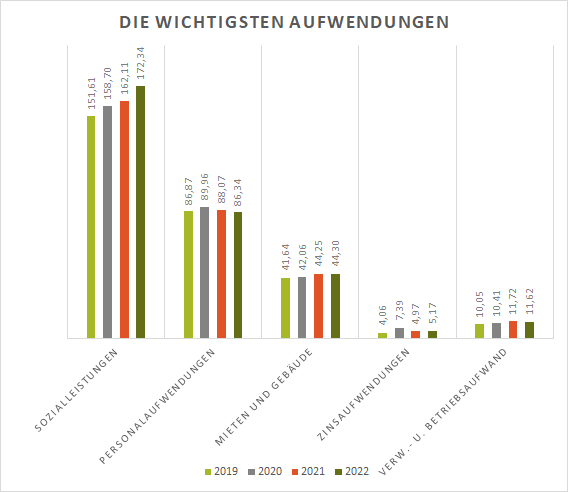
Income from financial equalization had to be reduced by EUR 5 million for 2021 and the additional expenses for economic youth welfare increased by EUR 1.96 million. There were also cost increases in personnel expenses amounting to 2.34 million euros. Despite these negative developments, there are also some positive items: There is an increase in income in the amount of 7.51 million euros in the area of SGB II and XII and the integration fund in the amount of 1.32 million euros. This illustrates the expectation of further support payments from the state of Lower Saxony.
In addition, the reversal of personnel provisions recognized in profit or loss led to an improvement in earnings in the amount of in the amount of EUR 3.83 million. Despite exploiting all savings opportunities, it is not possible to present a balanced budget within the meaning of Section 110 (4) NKomVG: The 2022 contribution budget shows a deficit of €47.14 million in the income budget. Compared to the medium-term planning for the 2022 budget, which expected a surplus of EUR 1.09 million, this results in a deterioration of EUR 46.05 million. This is mainly due to the downward adjustment of trade tax income. Even for the planning year 2022, it will not be possible to balance the budget either in the planning year or by the second year of the medium-term plan.
The after-effects of the Covid-19 pandemic will also remain clearly noticeable in 2022. The severe cuts during the lockdown cannot be fully absorbed within two years. Trade tax therefore had to be recalculated at EUR -47.15 million. A loss of EUR 4.2 million is also expected for municipal companies in 2022. A deterioration of EUR 14.01 million is due to an increase in the number of cases and the increase in the care rate in the area of integration assistance. This will be offset by additional income from financial equalization in the amount of EUR 9.38 million. From 2020 onwards, the federal government will contribute a higher share of the costs of accommodation in the amount of EUR 7.79 million per year. Lord Mayor Frank Klingebiel played a key role in this permanent financial support from the federal government and the financial support from the state in 2020 in his roles as Vice President of the Association of Cities and Towns of Lower Saxony and member of the Presidiums of the Association of German Cities and Towns and the German Association of Towns and Municipalities.
By limiting investment measures to the most necessary level, there will be a considerable net debt reduction in the overall planning period. The expected debt reduction as of the 1st supplementary budget 2019/2020 in the amount of 8.43 million will be improved by a further €1.86 million and will lead to a debt reduction of in the amount of 10.29 million euros. The slight improvement also means that repayments will increase in the coming years. In perspective, this shows that we will be able to absorb the abolition of the road expansion contribution statute. Borrowing for 2021 amounts to EUR 14.63 million and is broken down into core administration EUR 10.3 million and in-house operations EUR 4.33 million. For 2022, the borrowing authorization amounts to EUR 14.27 million and is divided into core administration EUR 11.20 million and own operations EUR 3.07 million. In addition, credit authorization for the SRB in the amount of 10.8 million for the SRB. The borrowing requirement results from the closure of the Fuhsetal landfill in 2023 for EUR 4,030,000 and in 2024 for EUR 6,823,000.


 read out