Current information:

On the basis of this approval notice (303,000 cubic meters), the German government began preliminary work on the construction and operation of the nuclear repository for low and intermediate-level radioactive waste.
A few years later, the federal government realized that around twice this amount (around 600,000 cubic metres of low and medium-level radioactive waste) was available. However, Konrad is only approved for 303,000 cubic meters.
The planned expansion of the shaft from Berlin has met with rejection throughout the region, and its general suitability is also in doubt.

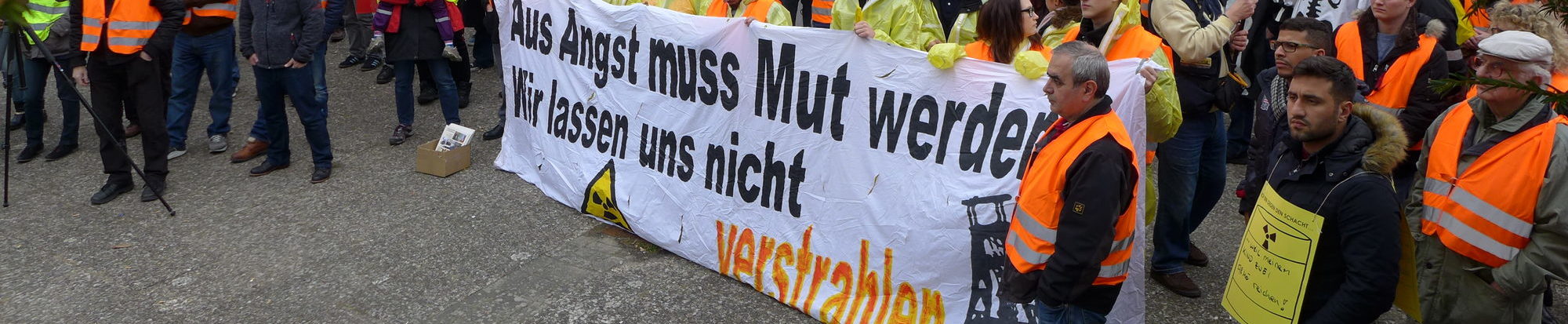
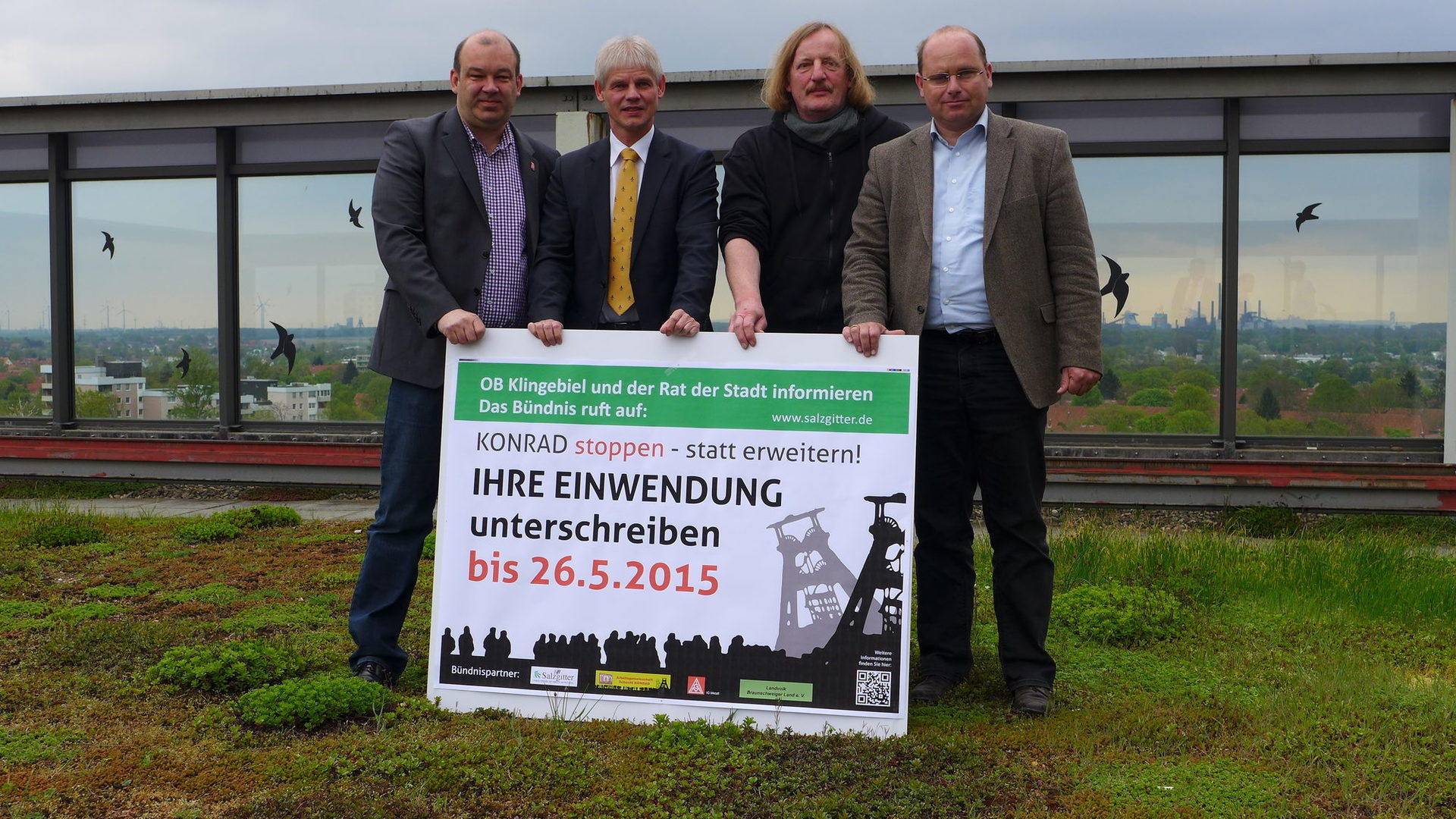
On May 28, 2015, around 70,000 signatures collected as part of the four-week objection campaign "Stop Konrad - instead of expanding" were publicly handed over to the Federal Ministry for the Environment in Berlin. A partial success was achieved on August 12, 2015: The German government announced that an expansion of Konrad was now no longer planned.
In December 2015 / January 2016 (as of January 19, 2016), 19 regional authorities in the region have now adopted a joint appeal to demand a reassessment of the "Schacht Konrad" project in line with the current state of science and technology. From a scientific (and human) point of view, this reassessment can only result in the conclusion that the Konrad mine is not suitable as a storage site.
In particular, the Federal Government demands
- The permanent binding exclusion of an expansion of Schacht Konrad.
- A comprehensive reassessment of the Konrad mine in accordance with the current state of science and technology, including the safety calculations and analyses that are more than 25 years old.
- The consideration of an option for the retrievability of all nuclear waste to be disposed of, which is not given at the Konrad mine.
- The revision of the Konrad transport study for a realistic and up-to-date assessment of transport risks, including the possible effects of transport accidents.

On 19 January 2016, Federal Environment Minister Dr. Barbara Hendricks visited Salzgitter around a year and a half before the 2017 Bundestagswahl to discuss the future of Schacht Konrad with political and social leaders.
One of her key statements was that "there can be no absolute safety for people when it comes to the storage of nuclear waste." According to Hendricks, however, the current German government believes it can take responsibility for this (from faraway Berlin).

When people asked why Schacht Konrad was not included in an open-ended site search, Hendricks could only give an evasive answer. The main administrative officials demanded that those responsible for these nuclear waste problems should take responsibility. In addition, retrievability must be discussed.
At its meeting on September 14, the Salzgitter City Council unanimously adopted the "Region 2022 appeal to reject a nuclear waste storage facility at Schacht Konrad". "This is a clear signal from Salzgitter to those responsible in the state and federal governments," emphasized Lord Mayor Frank Klingebiel.
As is known, according to the current state of science and technology, Schacht Konrad would be ruled out as a storage site for nuclear waste. In May 2021, the environmental associations BUND and NABU, together with the alliance "Salzgitter against Schacht Konrad", submitted an application to withdraw or revoke the planning approval decision. Nevertheless, the state and federal governments want the old iron ore mine to be expanded into a nuclear waste repository to the detriment of the region and billions of euros to be spent on it by 2027.
As a region, the state government is being called upon:
- To support the region in its rejection of a nuclear waste repository at the Konrad mine in Salzgitter.
- To process and decide on the application from BUND and NABU transparently, swiftly and faster than announced.
- To support the federal nuclear supervisory authority's demand for an immediate halt to construction in order to avoid creating any further facts in the ongoing application process.
- To express displeasure to the Federal Government that the responsible Federal Minister for the Environment, Steffi Lemke, is not prepared to talk to the alliance in Salzgitter and the people affected.
The region is calling on the federal government to
- To include all low- and intermediate-level radioactive or non- or low-heat-generating waste in the site selection procedure for high-level radioactive nuclear waste or to immediately begin a separate, but similar in content, site selection procedure for low- and intermediate-level radioactive or non- or low-heat-generating waste.
- To stop the work at Schacht Konrad and to use the financial resources earmarked for further expansion for a transparent and participatory site search for all low- and intermediate-level radioactive waste.
- The consideration of an option for the retrievability of all nuclear waste to be stored.
- To immediately send the Federal Environment Minister Steffi Lemke to Salzgitter to address the positions of the "Salzgitter against Konrad" alliance and the city of Salzgitter and to be available for a discussion.
The responsible alliance partners (AG Schacht Konrad, IG Metall, Landvolk, City of Salzgitter) are united in their goal of continuing to take legal, political and imaginative action against the Konrad project in a variety of ways.
The Konrad mine is a former iron ore mine located in the south-eastern part of Lower Saxony near Salzgitter-Bleckenstedt. After the two shafts were sunk between 1957 and 1962, the iron ore deposit formed around 150 million years ago was mined to a depth of between 900 meters and 1200 meters until 1976. Around 6.7 million tons of iron ore were extracted. The mine proved to be exceptionally dry, as clay and marlstone several hundred meters thick formed a natural barrier above the ore deposit.
Further information on the Internet:
You can also read here:
To download:
- Jürgen Kreusch: Schacht Konrad - Notes on the ÜsiKo (Final Report on Phase 1):PDF-File691,48 kB
- Wolfgang Neumann: Evaluation of results reports for phase 1 in the context of the ÜsiKoPDF-File824,57 kB
- Cities and municipalities that have so far agreed to the region's appeal As at 22/09/2016PDF-File11,74 kB
 read out